

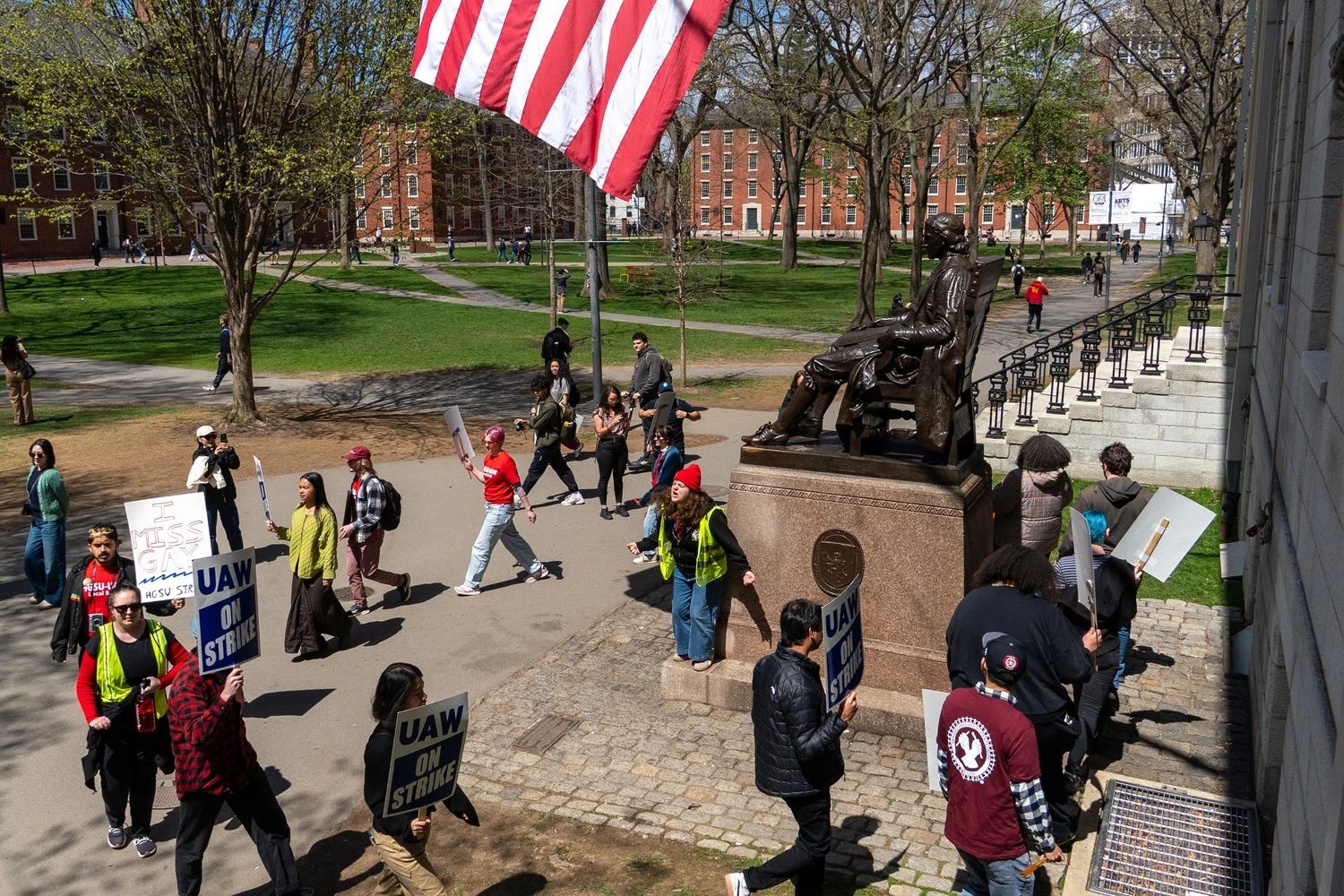
My grandfather, a refugee from the modern-day Democratic Republic of Congo, spent his career working for the Canadian postal service. He was a union member. The Canadian posties were never shy about a fight. Their union defied Parliament, the union president was jailed, and the strikers got maternity leave for workers decades before it was fashionable. I grew up respecting that tradition. Unions like my grandfather’s fought hard for real things: fair pay, job security, protections that actually showed up in workers’ lives. What is happening at Harvard is not what my grandfather’s union was. The posties fought for their members. The Harvard Graduate Student Union (HGSU) is using its members to fight for itself. This is because, as we will show, the HGSU is trying to use these strikes as a way to take over Harvard and repurpose it as the center of a Communist revolution.1
While they publicly advertise their demands on immigration policy and academic freedom, these demands are a smokescreen for their true motivations. Harvard is already doing much of what the union is demanding on these issues through daily SEVIS monitoring, a 24-hour emergency attorney hotline, and active federal litigation on both issues. Indeed, the union has recognized their demands amount to little more than the “formalization” and “codification” of current Harvard policies. These wedge issues delay negotiations and polarize campus while inevitably resulting in nothing except for the continuation of the status quo.
The real demands which the HGSU are making are, rather, about seizing power for the union. For instance, look at the HGSU’s demands on Title IX. Currently, Harvard uses the imperfect, but legally required, Title IX system, ensuring that the accused get a fair hearing. However, the union wants to change this system to get rid of basic due process. Instead of the current system, the HGSU demands that the school allow the HGSU to “investigate” and “arbitrate” cases “without necessarily waiting for the University to conduct an internal investigation.” What this means is that the union would be able to unilaterally punish and even remove professors, for reasons completely opaque to anyone outside of union leadership. This is a ridiculous, unprecedented policy. It is also obviously illegal, a fact in light of which the union has refused to change their demands.
The HGSU has defended their demands by saying the only options are Title IX or union control. That is a false dichotomy. Columbia’s graduate union contract requires Title IX cases to exhaust the university’s internal process before proceeding to outside arbitration, preserving federal protections for victims while adding an independent appeal option afterward. Stanford’s graduate union won a grievance procedure operating in tandem with the Title IX office with third-party arbitration as a backstop after internal processes. Both institutions gave workers real recourse without bypassing Title IX. But this is not the same as the HGSU’s proposal. The HGSU has demanded a policy that simultaneously gives the least standing to victims and the most power to union apparatchiks. This union-first policy has never been implemented at any other university. It is a power grab dressed in the language of survivor protection.
Further, the union’s demands on pay are more about enriching union leaders than ordinary graduate students. The HGSU has demanded an increase in pay for the average graduate student of 12%. Harvard has agreed to an 11% increase. But the HGSU is not happy with this offer. This is because the offer does not meet one of their main demands — cutting graduate students’ wages. The HGSU has demanded Harvard force graduate students to pay the HGSU dues — even if graduate students are not members of the union — in order to increase pay for union leaders. At a school where the graduate student union is extremely unpopular, the HGSU is paradoxically demanding Harvard cut the wages of Harvard students while increasing pay for union leaders.
This demand is even more ridiculous when we recognize that little of these dues will ever go back to the Harvard ecosystem. Last year the HGSU collected $757,578 in dues from roughly 2,000 dues-paying workers. Roughly 60% was sent directly to the UAW. Of the $300,000 remaining locally, more than half goes to salaries and benefits for three external organizers. The rest covers Google Workspace accounts, legal fees, and political lobbying. The worker paying $379 a year sees roughly $150 of it stay in Cambridge. The remaining $227 flows to a national apparatus that funds partisan left-wing political campaigns such as Kamala Harris’s presidential run. If Harvard gives into union demands, HGSU’s dues collection would more than double to over $1 million annually, with the same 60% flowing to national left-wing politics. If Harvard is serious about “viewpoint diversity” and “academic freedom,” forcing students to give to left-wing political organizations should be a complete nonstarter.
Indeed, the HGSU’s other demands on wages are equally strange. Their primary demand on wages is to increase pay for an extremely small subsector of Harvard students. Harvard pays graduate students $45-50,000 per year for the first 5 years. After this, Harvard covers tuition and fees and pays students over $25,000, but since students no longer work for Harvard full-time, they no longer get full pay. Students in STEM, who still work full-time in research labs, still receive $50,000 annually.2 This is a sensible policy. Those who do not work full-time should not receive full-time pay. Further, it is very difficult to take in new PhD students when the same PhD students are being paid after a decade of being graduate students. It also affects a tiny minority of Harvard’s student population. Most students receive their PhD within 6 years. 96% receive their PhD in 8 years.3 This is hardly the most pressing issue faced at Harvard. But it makes sense as a central demand when we look at the people who run the union. For instance, Denish Jaswal, who leads the union in negotiations, is an eighth-year PhD student with no signs of graduating. The union is at this point seeking an increase in union leaders’ wages paid for by cutting the normal graduate student’s wages.
This callous policy is motivated by a mission that views Harvard’s graduate students as a mere building block of a broader political project. The pattern of HGSU leadership tells the story directly. The founder of the union, Brandon Mancilla, led the 2019 strike coordinating team he described as “planning university disruptions,” before leaving his doctoral program entirely for election as a regional Union Chapter Director at $223,744 a year. He told the Young Democratic Socialists of America that his goal in leading strikes is to “change the entire landscape of power in this country.” This deserves repeating. Mancilla’s goal was not to get Harvard’s workers a raise. It was to change the “entire landscape of power.” It was to lead a revolution. The union was then led by Evan MacKay, who later left to run for Massachusetts State Representative on the DSA ticket, described the union as having the purpose of supporting the “socialist movement” and “climate justice.” Not, of course, actually helping students. The question the union does not want asked is simple. Is the HGSU an organization that represents graduate students or a launching pad for activist careers dressed in the language of labor solidarity?
The current leadership seems far more committed to the latter goal. The current president is Sara Speller, a fifth-year Music PhD candidate. Her published research examines how Western classical music enforces what she describes as “supremacist ideology.” The Vice President, Sudipta Saha, introduces himself on the union’s official executive board page that his passion is “not” improving “material” conditions for workers (that is, the point of a union) but rather building a “militant” union for “internationalist causes.” He has further proposed naming the union Halloween party after the opening line of the Communist Manifesto and, on an official level, recommends a Marxist podcast to union members. Indeed, the union’s bylaws commit the organization to “solidarity” with “progressive organizations” before any reference to wages or labor conditions.
Neither Mancilla, President Speller, nor Vice President Saha responded when asked for comment by the Harvard Salient.
This explains why the union has been completely uninterested in actual negotiations. After fifteen months and sixty hours at the table the union has agreed on two articles out of twenty-five. ICE non-collaboration clauses are not mandatory bargaining subjects under the NLRA, meaning the union has little leverage to push Harvard to negotiate on them. Harvard’s lawyers correctly identified this and used it as cover while the union spent nine months on proposals the school had no legal obligation to discuss. Harvard’s own working group said urgent action was required on wages. A union focused on wages would have spent fifteen months on wages, an issue on which Harvard was clearly willing to negotiate. This union did not, because wages were never the point.
The HGSU’s open political extremism is why most Harvard graduate students do not support it. Only 1,700 of the claimed 5,500 workers pay dues. Nearly 68% of covered workers have declined to fund the organization. In its own materials, the union shows nothing but contempt for this silent majority, who they dismiss as not doing their “fair-share.” Indeed, union leaders allegedly sent messages warning graduate students that continuing to teach would be viewed as a “betrayal,” and union representatives have gone around campus monitoring compliance by fellow graduate students. In a field like academia where connections determine success, the HGSU’s thought-policing cannot be viewed as anything but threats to unaligned graduate students. To force students to give to this unpopular, extremist organization would be to betray them. It would be to put national left-wing politics over the concerns of Harvard students.
Harvard must retain its resolve against the HGSU, which is fundamentally negotiating from a place of weakness. The HGSU is deeply unpopular among graduate students. Normal graduate students looked at an organization whose VP wants to build a militant internationalist movement, whose dues fund presidential super PACs, and whose hardship fund runs through the DSA, and decided this was not an organization they wanted to fund. That is not freeloading. Harvard has rightly refused forcing these students to fund the HGSU across three consecutive contracts. If it turns its back on graduate students by negotiating with the HGSU’s extremist leadership, it will only legitimize an organization trying to threaten and attack its way to power. If it gives into the HGSU’s absurd demands on Title IX, it will make Harvard into a union-controlled school.
This is not to say nothing should be done to help Harvard’s workers. The fix is concrete: close the funding cliff, extend the humanities guarantee to six years like Yale and MIT, and pay workers what peer institutions pay theirs. None of this requires a Marxist VP, all-powerful thought police threatening professors and students, or funnelling graduate students’ money into national politics. Indeed, Harvard has already recommended what the strikers want. The goal, for union leaders, however, was never to close the gap. The goal, stated plainly by the people running this union, is self-enrichment through international revolution.
My grandfather’s union got him fair pay and decent working conditions. It did not force members to give money to presidential campaigns. It did not aim towards international Communism. It did not spend all its time trying to enrich and empower union bosses. It did not send coercive messages to workers who just wanted to show up and do their jobs. Harvard’s graduate workers deserve that kind of union. What we have instead is a spectre. Until the HGSU replaces its leadership, Harvard must end these farcical negotiations. We cannot negotiate with extremists who want nothing less than total control over the university.
And the people most at risk from the HGSU are the ones they claim to protect.
Every claim we make here is sourced to official union materials, federal filings, or the leaders' own published statements.
While the hyperlinked source only discusses biology, wages are standardized across STEM departments, and thus, we have reason to think research assistants in other STEM fields are paid a similar amount.
It is likely that even fewer than 4% of graduate students are affected by this, as PhD students in STEM who work in research labs are far more likely to spend far longer in PhD programs than humanities students. STEM students who work in research labs, as we discuss, are not affected by this policy change.
I am shocked that Harvard is actually giving PhDs to people who study how to denigrate classical music by tying it to white supremacy!
That is not liberal arts. That is the destruction of liberal arts.
Yikes. Sounds like a pretty scary union!
BTW, does Harvard educate any auto workers at all? If not, then what is the UAW doing there in the first place?
If, as I seem to recall, Harvard was able to ban the US military from recruiting on campus, then shouldn't it also be able to ban the UAW from recruiting on campus?