

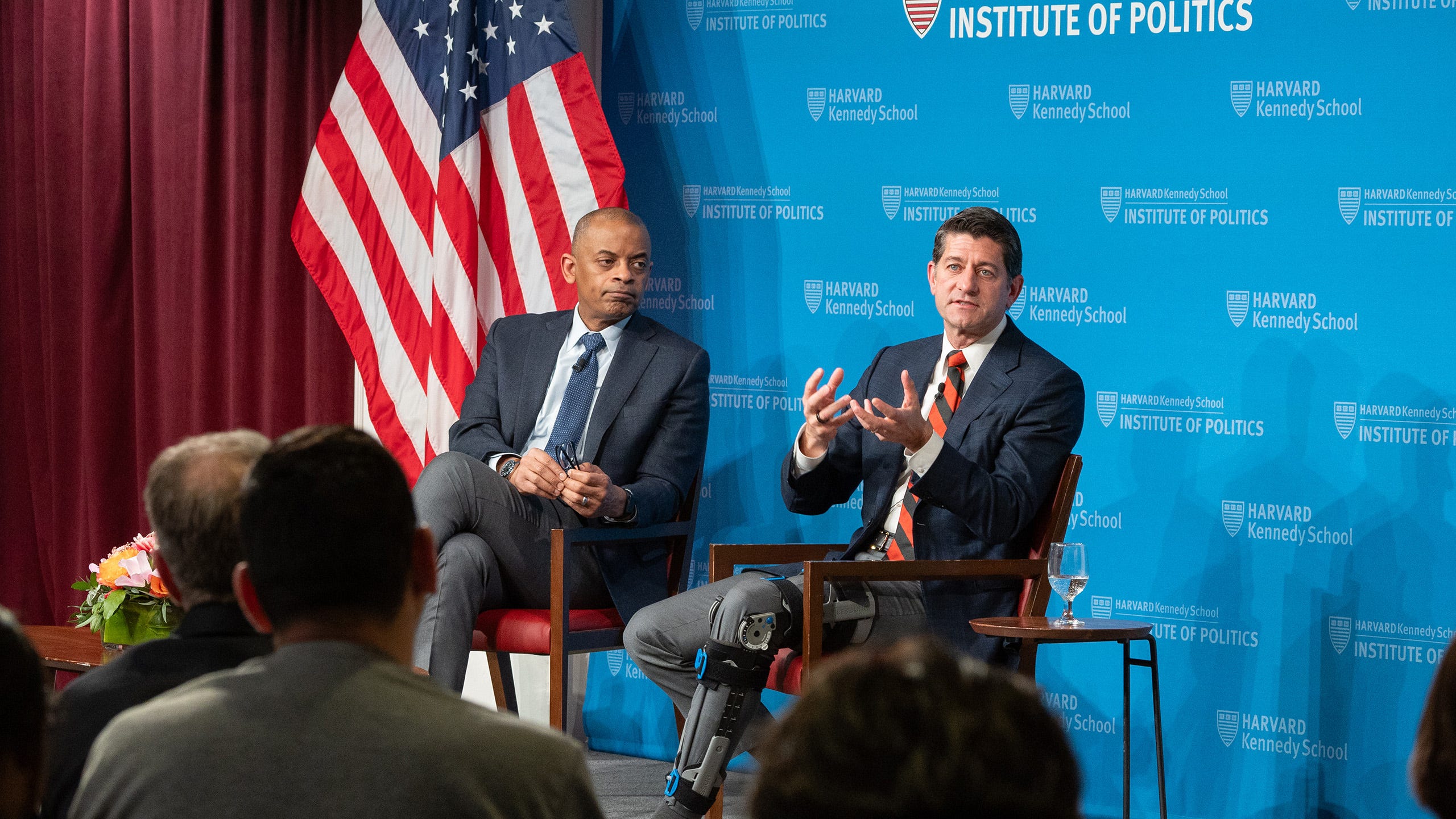
On March 26, former Speaker of the House Paul Ryan discussed his career and America’s political future with former Secretary of Transportation Anthony Foxx at Harvard’s Institute of Politics forum. Ryan argued that America’s current ills are caused by a “populist” moment fostered by social media that treats politics as “entertainment.” Instead, Ryan argued that America needs “evidence-based analysis” about “what works” through the traditional institutions of policymaking.
Throughout the night, a belief in Congress’ institutions and consensus-making practice animated Ryan’s arguments. He argued that Congress had unduly lost power to the Executive Branch, pointing out that “the legislative is the more powerful branch in our constitution,” something which Presidents on both the right and left had forgotten. He argued that modern politics has been taken over by “entertainers” who just wanted to “get famous,” supplanting legislators “who wanted to do something.” Instead, we need to return to a focus on “evidence,” a repeated focus of his remarks. In our current “TikTok culture” a “majority” of legislators in Congress are now there not to debate policy but to entertain their supporters, damaging our political culture.
Ryan argued that the populist era had facilitated the rise of a form of conservative “nationalist populism,” which he argued is not even a form of conservatism. Instead, it is a form of “paleo-conservatism,” based upon “blood and soil nationalism” and “moral relativism,” that rejects the fundamental tenets of American conservatism. In its place, Ryan advocates a return to the conservatism of his day, one which is not the defense of a value system or nation-state but rather a “classically liberal” political culture, which is based upon “a rich tradition of great thought that goes back to the Enlightenment,” one which defends “liberty, freedom, self-determination, pluralism…equality of opportunity, not equality of outcome, and [conservatives] premise all of this on a philosophy of natural law.” This conservatism, in Ryan’s view, is based upon the view that America “is built upon an idea,” as opposed to being built upon long historical “legacies.”
Yet, Ryan did not simply seek to defend the traditional institutions which have been supplanted in the Trump era. He openly recognized that attempts to “extend the Reagan era,” which he supported, were rejected in 2012 and the 2015-16 primaries, beginning a “new era” for conservatives. Further, he recognized that much of what he sought, like a “Congressional Commission” that would resolve the ballooning national deficit in a bipartisan manner, is unrealistic in today’s era of polarization. Nevertheless, he argued that some “scare big enough” from the “bond markets,” or the American “people getting sick of” our entertainment-focused political culture among voters, could lead to “a political incentive structure” dedicated to fixing problems.
Ryan said, thus, that whatever comes next will not be just an extension of Reagan-era conservatism but rather a set of new political “solutions” to new political problems that are being thought about at places like the “American Enterprise Institute.” He argued that a new political perspective would take hold after Trump’s tenure ends, as Trumpism is not based on “a set of core principles” but rather a “cult of personality.” It is odd that, while recognizing that the policies conservatives will advocate for in the future will never return to Reagan-era conservatism, Ryan nevertheless seems to believe that the basic conservative ideology which underlies those policies will revert to the consensus-based fusionism of the Reagan era.
It seems quite unlikely, however, that we will return to the Reagan-era consensus about the basic goals of America. We are not in the Cold War era in which the ideas of Ryan and his political mentors were incubated. As national security concerns no longer unify us, no clear consensus understanding of America is taught at schools or universities, and our culture rapidly fragments, Americans increasingly do not share the same cultural or even informational sources. It seems highly unlikely that the Reagan era and the overlapping consensus upon which it was based will return any time soon. While the rise of ideologically empty populism is to be lamented, what it displaced is nevertheless unlikely to return, no matter whether people get sick of the current wave of political populists.
Even though many of the ideas which have historically animated the American conservative movement have lost public purchase, that does not mean that American conservatism will be itself without ideas. Instead, what it means is that we must recognize that conservatism is not encompassed by the classical liberal political goals which Ryan described. Throughout the discussion, Ryan alluded to cultural aspects of conservatism – assimilation of immigrants, a “social contract” based on a “safety net for the poor,” and the rejection of modern “TikTok culture” of “fake it ’til you make it.” These arguments seem to be based on not just a political conservatism but a moral conservatism as well, one which values the basic moral and cultural ideals that unite America as well as our political ideals. Classical liberalism alone cannot defend against threats to these ideals.
Instead, we must recognize that our contemporary political debates are fundamental moral debates that require moral solutions. TikTok culture is not just a political plan for a government but a moral plan for our lives. This culture requires a response not just in political but in moral terms. Conservatism must therefore seek to rebuild a new moral consensus justifying conservative political goals, not just appeal to a moral and cultural consensus that no longer exists. Only conservatism offer answers to the moral debates of the contemporary world.
Of course, basing a conservatism on moral values does not entail a rejection of America’s traditions of pluralism and ordered liberty. Instead it means a return to our Founders’ recognition that our classically liberal political values can be best understood in conjunction with morality, not abstracted from it. Thus, while Ryan is right that the future of conservatism will likely require new thought, he does not recognize how wide-reaching those ideas will have to be. Not only must the future of conservatism develop an economic plan for our new era, but it must also develop a cultural plan that can defend American values against the moral threats of this new era. Building this new moral consensus requires more than just trying to extend a Reagan era that has, sadly, long-since vanished.
I wish the article would have gone on to describe what is meant by a moral conservatism and detail how that would work.
Yes, morality is key, but what about just following the law?