

Political bias in Harvard’s academic offerings has become endemic. As previously cataloged in the Salient, Harvard Humanities departments in particular are dominated by left-wing ideology. Instead of learning about history or sociology, many students only learn a one-sided Marxist or critical theoretical perspective on history and sociology. Most attempts to explain this bias are purely based on professors’ perceived ideological bias. According to James Hankins, for instance, Harvard went woke because of irrational shifts in educational philosophy. By analyzing the history of Harvard course descriptions, however, we find something very different — Harvard shifted left because administrative social engineering made activism the only way for Humanities courses to survive.1
Prior to 2015, Harvard required students to take a range of courses across departments for their General Education requirement. In 2015, however, Harvard’s administration decided there were too many courses. So, they cut the number of courses by 20% and shifted to a new General Education system dominated by large, easy courses about four arbitrary “kinds” of education. This nearly inexplicable social engineering, as with all social engineering, led to unexpected, awful consequences.
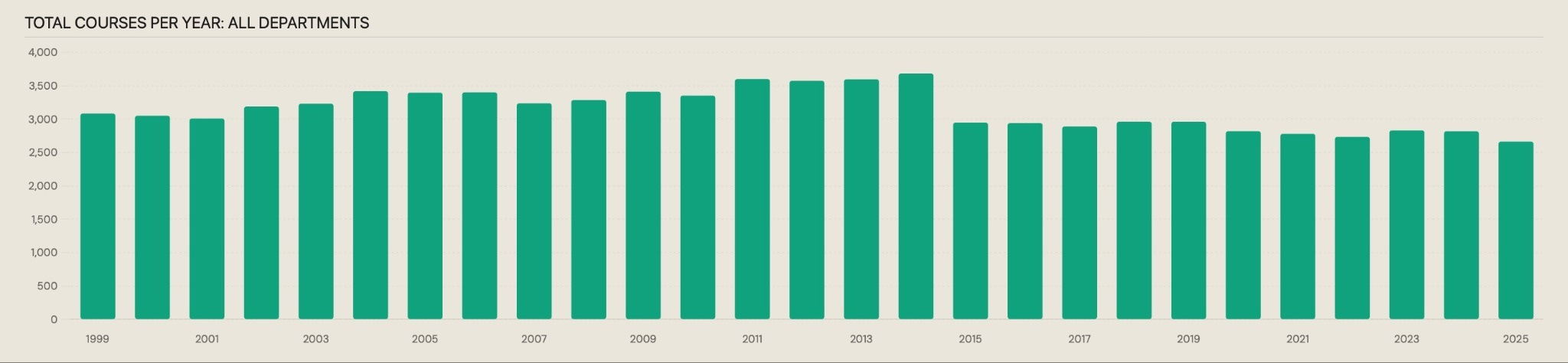
In the Humanities, these changes led to an unprecedented decline in the student population. Very few of the 20% of courses that were cut were engineering or science courses; indeed, the number of STEM courses at Harvard has only increased over the past 10 years. Instead, these cuts were targeted at the already declining Humanities. Since the 2000s, History has declined from the second largest department at Harvard to the eighth largest department, for instance. On the other hand, the number of Computer Science courses has grown nearly every year since 2010.2
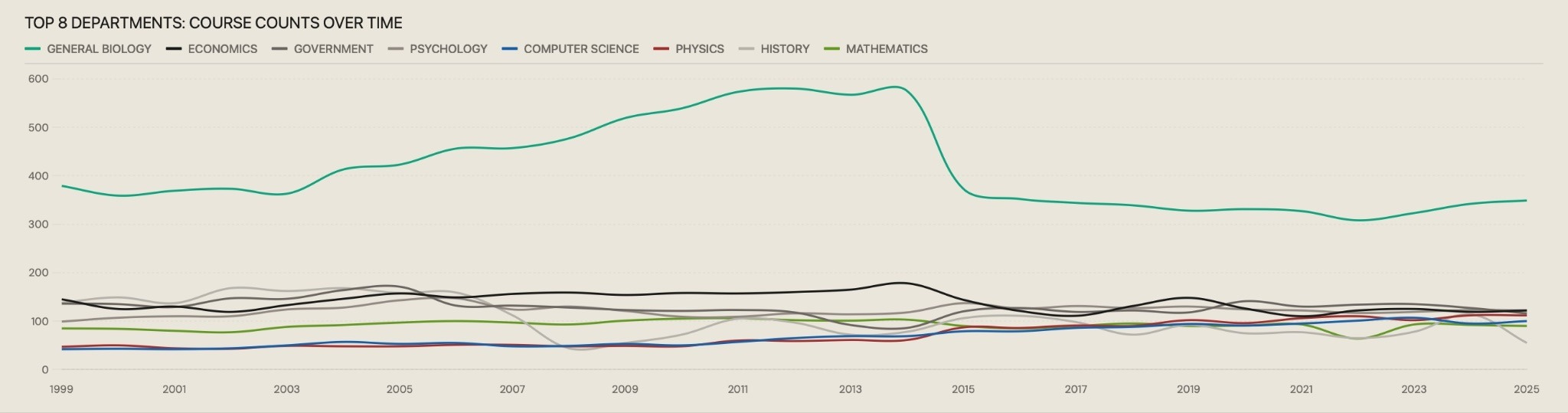
What this administrative social engineering meant was that courses that were too small were cut, even if professors were happy to teach them. Now, Harvard teachers had to compete for student interest in order to teach. Making this even worse, the same year that Harvard cut the number of courses, they also implemented an online Q Report system, allowing students to review courses and professors online for the benefit of future students. The implementation of the online Q Report system, however, had the unfortunate effect of allowing every single student to decimate future enrollment in courses by writing a strongly worded negative review of that course. Indeed, Harvard specifically facilitated this policy, telling students to describe on their Q Report if their professor said anything they viewed as “offensive.” As a result, Harvard professors now have to make sure they do not offend even a single student, or else their courses may be cut next.
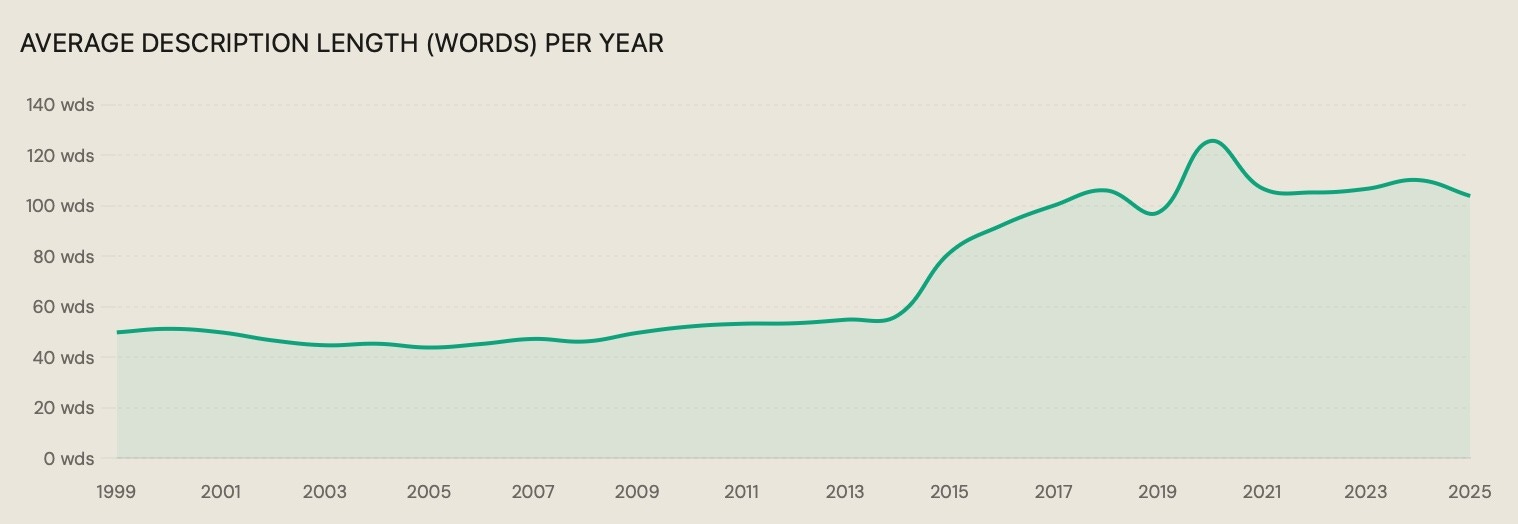
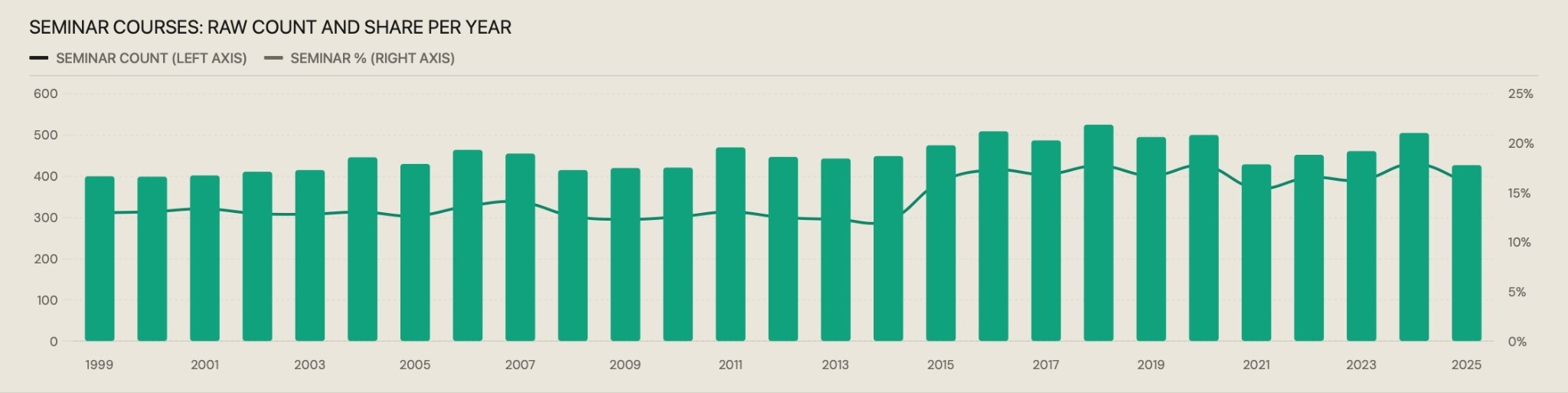
Due to this growing fear, Harvard’s Humanities offerings are now determined by student preference rather than faculty teaching. The number of words in course descriptions has increased dramatically, as these descriptions have changed from professors trying to explain their courses to practically begging students to take an interest. The shift in the number of courses has also affected the sorts of courses Harvard offers. Once a place where students could learn from the greatest Professors in the world, Harvard now enables students to indulge in their preferences to hear their own voices instead. As a result, over the past ten years, there has been a consistent increase in the number of seminar courses and a decline in the number of lecture courses.
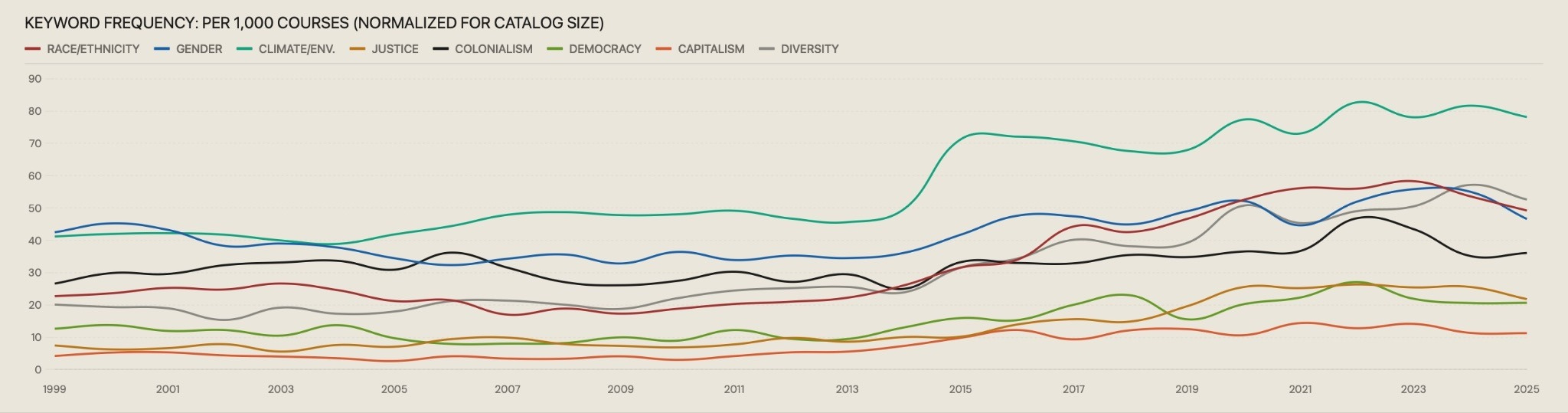
As has previously been noted in the pages of the Salient, 2015 was the year when Harvard’s wokeness problem became septic. In course descriptions, we find both a proof and an explanation of this failure. Proving the point, we see in the data 2015 as the year when the number of left-wing keywords (such as “race,” “climate change,” and “diversity”) starts to increase dramatically in course descriptions. While it may seem like 2015 has been picked as an arbitrary line in the sand, our data shows there is significant evidence that this year was a real turning point. Second, we can see from the data that the reason for the left-wing shift was the same as for the increase in the number of words in course descriptions: the need for student interest. When a single activist student can destroy a professor’s career with an especially negative Q review, it is not surprising professors start teaching whatever activist students want. Harvard has created an incentive structure in which courses become activism or else disappear.
This problem is particularly pronounced in departments that rely on non-tenured faculty. History & Literature is the largest department at Harvard that relies almost exclusively on non-tenured visiting lecturers. These non-tenured lecturers are dependent on student interest each and every year in order to keep their jobs in the short run. This means that offending a single activist student (and thus getting a mean Q review) can often end a lecturer’s academic career. It is no surprise that the increase in the number of words per course description has been most pronounced in History & Literature, as a result. Equally, it is not surprising that History & Literature courses include some of the most ideological, left-wing language, simply as a method of self-preservation. History & Literature’s ideological tilt has become so extreme, in fact, that, as the Salient has previously noted, not a single course offering in the 2025-26 year in the department included even one conservative secondary source.
What this data importantly reveals is that Harvard’s problems go much deeper than just the institution. As Florida Governor Ron DeSantis found battling the College Board, critical theory is often taught to excelling high school students in the humanities. While DeSantis managed to remove critical race theory from the Florida curriculum, that did not mean the end of ideological indoctrination. In extracurriculars like high school debate (in which over a quarter of Harvard students participated during high school), the primary view debated is whether we should kill all Caucasians or just the rich ones.
Thus, we can see that Harvard’s problems with activism are not solely created within the university — they also result from secondary schools indoctrinating students before they even step foot on Harvard’s campus. Harvard’s intellectual diversity problems have been most extreme within the Humanities simply because Humanities professors are forced to cater to activist students’ preferences in order to be able to keep teaching classes.
The fact that Harvard’s problems have not solely been internally generated, however, does not mean that Harvard is innocent in this story. Its decisions over the past decade, from telling students to report “offensive” professors in the Q Report to its drastic cuts in the number of courses, facilitated the creation of an ideologically lopsided environment. Throughout its entire history, the university has had the important role of offering students new perspectives from which to learn. That Harvard has deliberately lost its ability to teach new perspectives in the past decade has been a terrible loss, something which Harvard’s administration has facilitated, if not caused.
The first shift that Harvard can make to broaden the intellectual environment is to undo the indefensible social engineering at the root of current ideological bias. The 2015 change in the General Education system is a failed experiment which should be abandoned. The current General Education system, by artificially reducing the number of courses taught, makes professors too dependent on student interest. If we remove the cap on the number of courses, professors will no longer have to fear lost student interest, removing the incentive for left-wing activism.
We need similar reform to the Q Report. Of course, information about the number of hours a course requires every week and the quality of professors is important. But we do not need a culture of peer pressure where each and every student justifies or rejects a course via dissertation-level essays. By getting rid of the comments on Q Reports, individual activist students’ idiosyncratic beliefs and preferences will matter less, and thus, professors will be able to teach courses without fearing individual students. While this will not be a perfect answer to our problems, it can be part of the solution.
Just undoing administrative social engineering, however, will not be enough to bring back Harvard from this precipice. The effects of Harvard’s decisions were not just administrative but cultural. Students have become used to never facing any pushback to their opinions — and in the rare instances when they do face pushback, they are often outraged. The Harvard Crimson has a column in which students literally complain that Economics professors do not state their left-wing political opinions frequently enough in class to properly comfort their students. If, tomorrow, we abolished the Q Report and the General Education system, these students would still use whatever methods they could find to pressure professors into left-wing activism.
Thus, removing bad administrative policy cannot, alone, fix our problems. What we need, instead, is culture change. This means action to return Harvard’s culture to one of real viewpoint diversity. Students should not have to worry about being overridden by their professors (or other students). Professors should not have to beg activist students (or activist professors) not to end their careers. Harvard’s President has publicly stated that he wants to bring viewpoint diversity back to Harvard. The only way to follow through on this promise is by action to no longer favor activists over intellectual seriousness. The question is whether Harvard’s administrators, students, and professors will have the courage to reform Harvard’s culture into one of Veritas rather than fear.
For this article, we used public data on the course description of every FAS course between the 1999-2000 school year and the 2025-26 school year, focusing on trends across courses. All descriptions of trends in course descriptions are based upon this analysis.
Computer Science experienced one year of a minor decline in the number of courses offered in 2024, but the number of Computer Science courses has increased every other year since 2014.
Harvard is horrifying
Well, that makes sense, and faculty would probably support the idea of reducing their accountability to radical students.
But, the problem with trying to change Harvard is that Harvard is an unfathomably bureaucratic institution.
Endless committees, reviews, feedback loops, and studies are required to evaluate proposed changes. By the time those are completed, the momentum for change has been forgotten, or changed into something new.
Reducing activism and promoting intellectualism is probably best achieved by the admissions office. Change the mix of incoming personalities and things will change, though there should be changes at the faculty level as well.
Admissions changes can happen every year without being delayed by committees and studies and reviews. There is an unstoppable biological clock pushing admissions forward every year.