

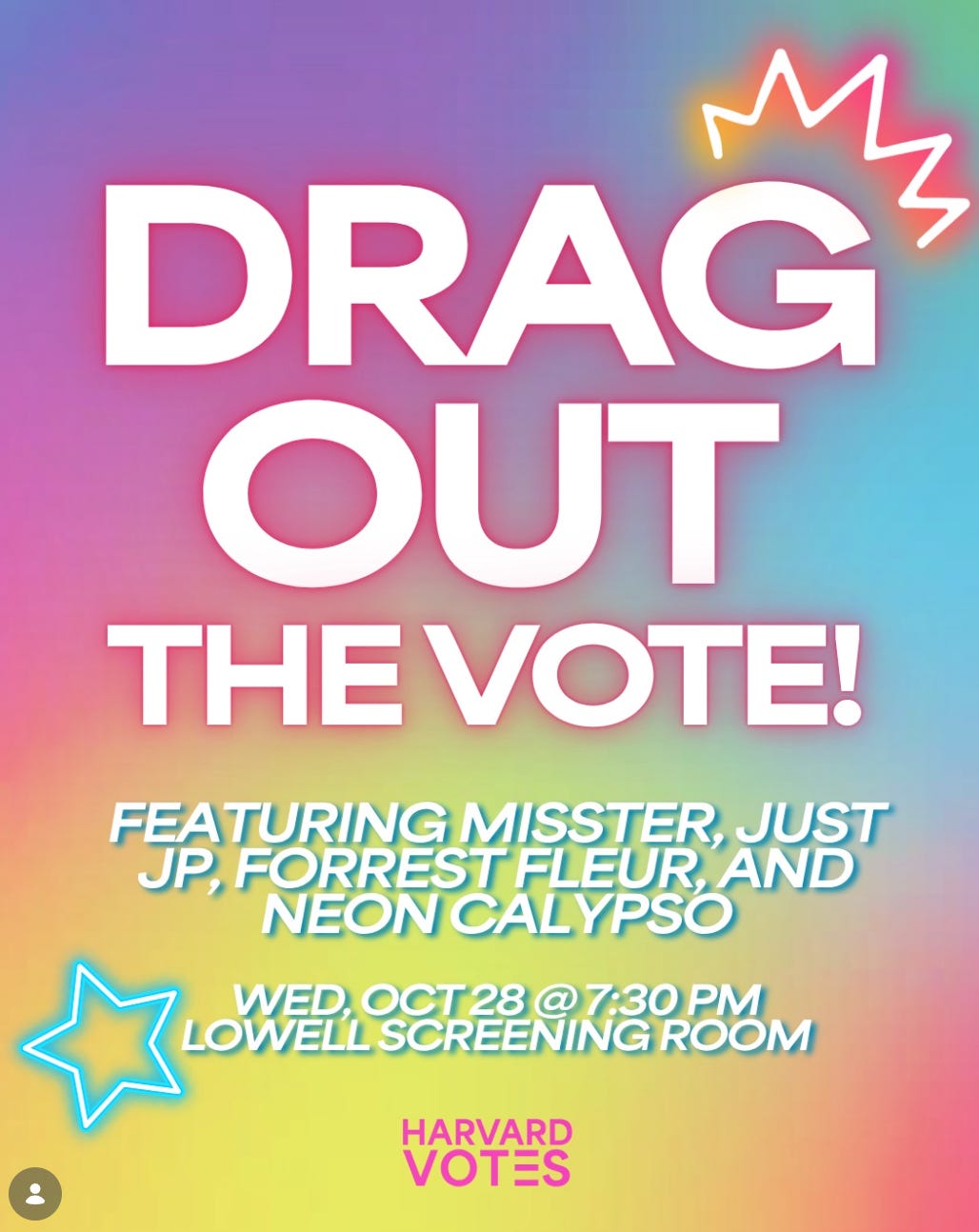
Capitalism intends to “pull out [its] penis and piss in your mouth,” to “rape the rich” and “ejaculate on the poor,” according to one Harvard Institute of Politics (IOP) guest speaker. Another declared Cupid a “naked little shit,” while a third lip-synced Beyoncé’s “Sweet Dreams.”
All three speakers were New England-area drag queens invited by the IOP, the Queer Student Association, and Harvard Undergraduate Queer Advocates on October 28. The IOP spent $1000, according to a source familiar with the event’s funding, on the “Drag Out the Vote” event as part of its Harvard Votes Challenge. Theoretically nonpartisan, other events in the series have included a pie bake with the Baking Club, “Buns and Ballots” at a dumpling restaurant, a watch party with the Texas and Ohio clubs, a “Rock the Vote” performer series, and mixers with the Harvard Vietnamese Association and the Chinese Students Association.
The eight students who attended “Drag Out the Vote” spent an evening at Lowell House learning that capitalism is responsible for slavery, racism, and the prison system, that the American economy sexually desires the rich and the poor alike, and that drag promotes “public health.” Notably, the Salient did not observe any student attendees pick up a voter registration form or ask questions about voting.
Indeed, the voting part of the voting event was notably brief: the first two performers recited a minute or two of boilerplate phrases about the importance of elections before their acts. One of them, who described moving to Boston from Charlotte three years ago, offered such novel sentiments as “Voting matters no matter where you are” and “Don’t be idle and sit at home”; mentioned ballot questions on cannabis and firearms, and then went on to lip-sync Beyoncé’s “Sweet Dreams.” The other, who went by “JP,” told the story of “her” path from El Salvador to American citizenship before describing Massachusetts’ 2026 ballot initiatives as “hav[ing] to do with, like, funding” and “whether businesses are able to be open or not.” JP was unable to name any of these ballot initiatives.
Another drag queen, Forrest Fleur, thanked the IOP and announced “her” job: a health researcher in the pediatrics department at Rhode Island Hospital who studies “queer and trans youth.” According to Fleur, it was “getting increasingly difficult” for researchers to win funding facilitating trans surgeries for kids because of federal restrictions on language, and since “my drag is a part of my public health work,” it was “so important” that the audience vote. Fleur then performed a poem about being “intentionally single and celibate,” a psychic’s prediction about the performer’s love life, and Cupid, “that naked little shit.” The Salient confirmed that Cupid is not running in any district in the 2026 Midterms.
Calypso, the headliner, is a Boston drag artist of more than 10 years. “She” declared that the basis of “her” interest in voting was the killing of Trayvon Martin weeks before “her” eighteenth birthday, at which point “she” developed a mission to “highlight voices of those that are oppressed, specifically queer and trans, non-binary bodies of color.” Trayvon Martin was, notably, neither queer, trans, nor non-binary. Looking over the room, Calypso added, “I don’t know about no trans, non-binary persons of color here at Harvard [sic].” The act “she” was doing, Calypso said, “about capitalism,” had been performed internationally and was one of the most requested acts in “her” repertoire.
What followed was a monologue in the first person. “I am capitalism,” the act opened. “Racism is my son. Gentrification is this sister. The jail system is my illegitimate daughter, and public schools are my badass grandkids.” Capitalism “gave birth to slavery,” put “drug dealers on corners,” and worked to make sure “them colored kids never go to college [sic].” In Calypso’s telling, Capitalism intended to “pull out [its] penis and piss in your mouth,” to “rape the rich” and “ejaculate on the poor.” The audience was then instructed to “bow down” and “sell your soul.”
The eight of us at the event were also not the only ones who heard the drag queens. One student, who asked not to be named, had seen the advertisement days earlier and thought little more of it. “I was shocked initially when I saw the flier,” the student said, “since I’ve heard so much about the IOP being partisan but had never seen it displayed so blatantly.” Then, sitting in the dorm lounge outside the theater on Wednesday night, the student “overheard explicit and vulgar commentary accompanied by music, vaguely connected to political themes of ending capitalism and taking down the rich.”
Perhaps, at this point, the IOP regretted what they had facilitated. As the program ended, a member of the organizing team assured the room that the performers’ statements were not necessarily endorsed by the hosts. But this was too little too late. The IOP paid over $100 per attendee to put on the show and publicly advertised the show on its official flyers and newsletter sent to thousands of students. How else can this be described but as an endorsement?
It’s not like the IOP could not have known this would happen. Objections were raised before the event, according to a person familiar with the details of the event: “I said, ‘Why the hell are we doing this? How is this nonpartisan? And who is it good for?’”
The individual’s questions were ignored because they exposed the contradiction at the center of this event: It is obviously not nonpartisan. Indeed, organizers have been open about that fact in the past. When Drag Out the Vote debuted in October 2024, the official flyer invited students to join in “highlighting the importance of protecting LGBTQ+ rights as the election draws near.” An IOP diversity director told The Crimson that the goal of the event was to get students to think about “Queer and LGBTQ+ rights” in the upcoming election. Thus, by the organizers’ own admission, Drag Out the Vote is plainly an advocacy event. As the IOP publicly declares itself “nonpartisan,” it nevertheless runs openly partisan events on the school’s (and thus donors’) dime.
The Salient sought comment from the IOP, Harvard Votes Challenge, and two other student organization co-sponsors on the event’s funding, how it was planned, what the organizers knew about the performers’ material in advance, how the evening advanced voter registration and turnout, and how it squares with the IOP’s nonpartisan mission.
The Queer Student Association said it does not respond to media requests, except on “matters of pressing concern to the queer community,” and that while it encourages students to vote, it had no further comment.
Carter Umphress, the Harvard Votes Challenge chair, responded that “HVC believes in hosting a variety of events to reach Harvard students wherever they are and encourage them to vote. I was unaware of what these performers would say and was under the impression that their performances would be strictly nonpartisan, in line with HVC’s identity. At the conclusion of the event, I thought it important to underscore that HVC does not endorse the views of the performers. HVC encourages every student, regardless of their views or background, to make their voices heard in these elections.”
Betsy Fischer Martin, the director of the IOP, said Harvard Votes Challenge is “a student-run, nonpartisan program that, within an allocated annual budget, hosts a range of events each semester to encourage students of all political perspectives to vote and participate in civic life.” She added that “the performers’ remarks were not shared with student organizers in advance,” and that HVC students “fully expected the program to comply with HVC’s non-partisan mission.”
The Harvard Undergraduate Queer Advocates did not respond to a request for comment.
A nonpartisan institute sold out its values for an event that no one even attended. Whatever the IOP intended, the event served the organizers’ politics better than it served turnout. They chose to fund the event, they chose to advertise the event, and they chose to give drag queens a room in a Harvard house where they could make extremist, sexually charged comments to students. Whether or not the IOP officially agrees with those comments, the IOP has nevertheless chosen to support them with its money and, sadly, its credibility as a nonpartisan organization.