

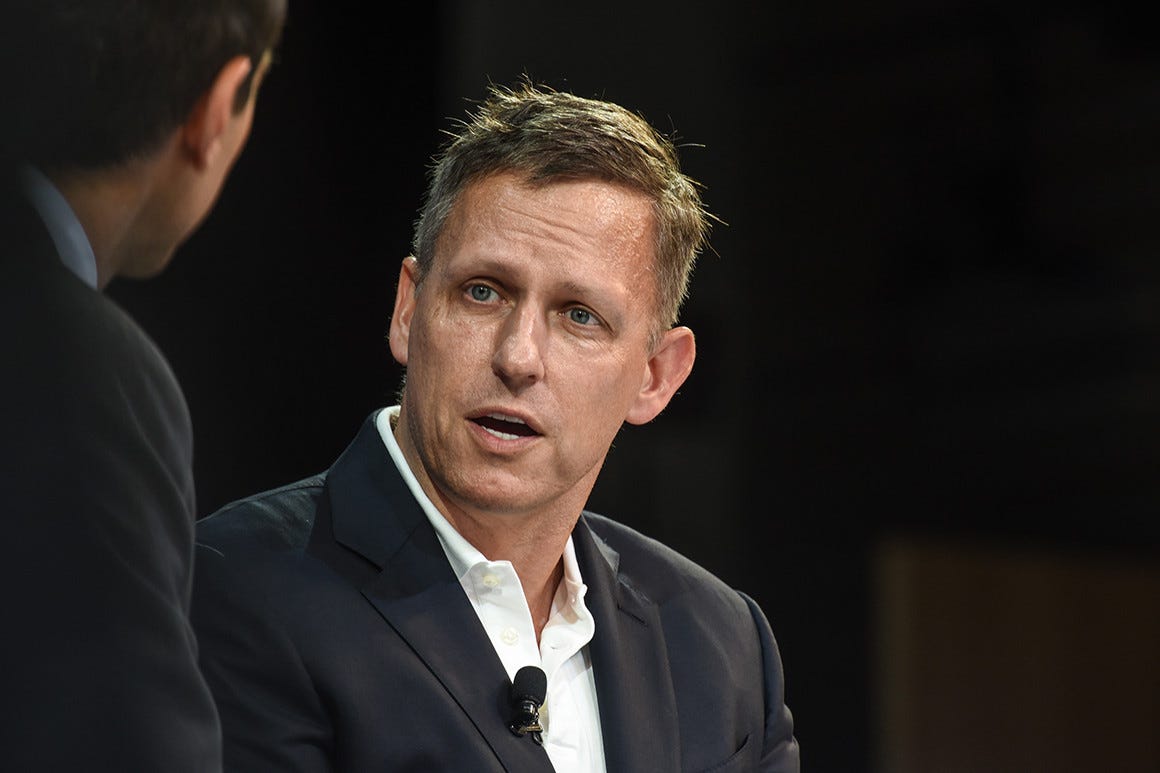
Peter Thiel is an entrepreneur and venture capitalist who co-founded PayPal, Palantir, and Founders Fund, as well as being an early investor in Facebook OpenAI, and many other major technology companies. He is also a major public intellectual on the right and a major intellectual influence on Vice President J.D. Vance. This interview is focused on his thesis, first articulated publicly in 2011, that technological growth has slowed since the 1970s, leading to economic stagnation.
THE SALIENT: You have argued that many of our current social and economic ills are the result of stagnation in scientific and technological progress over the past five decades. I’d like us to go through that process of decline. Mr. Thiel, what changes in the late 1960s and early 1970s do you see as beginning this long stagnation?
PETER THIEL: In 2026, the word “technology” usually means information technology and computers. One could call this a failure of imagination, but on another level, if we define technology as that which is progressing, our narrow-mindedness simply reflects our narrowed range of progress. By contrast, “technology” in 1967 would have meant computers, but also rockets, supersonic aviation, the Green Revolution in agriculture, new medicines, and more. Society was advancing on many different fronts.
I believe progress has slowed since then. How does one measure this? It is extremely difficult, but that is no excuse for nihilism. There’s a basic, Econ 10 intuition, which is that cornucopian tech progress should trickle into productivity gains and income growth, which we have not seen. The younger generations, starting with the millennials and their boomer parents, believe they will do worse than their parents, and unless something changes, I am inclined to believe them. Or there’s the literal question of how fast we’re moving—after building ever-faster sailing ships in the 16th through 18th centuries, ever-faster railroads in the 19th century, and ever-faster cars and airplanes in the 20th century, we hit a peak with the Concorde, which was decommissioned in 2003. If you factor in the post-9/11 airport security theater, we travel considerably more slowly than we did in the 90s. Or on health, life expectancies are not going up as fast as they were earlier in the 20th century.
I prefer to measure outputs than inputs, but there are around 100 times as many PhDs being produced today as there were in the 1920s. Even if we say things haven’t slowed, and we are making as much progress as we did in the ‘20s—when we formalized quantum mechanics, discovered penicillin, etc.—then the productivity of the average scientist is 99% lower today. That in itself is worth understanding and is at odds with the cornucopian story of progress that we normally tell.
Figuring out “why” we stagnated is even harder than the already difficult question of how much progress we are making. My cop-out answer is that “why” questions are over-determined. There’s a “nature” explanation—we picked the low-hanging fruit and ran out of ideas. The “nurture” explanation that I’m more inclined to, which is more optimistic, is that our culture changed, that people became risk-averse; science became feminized, bureaucratic, and regulated.
This happened, in part, for understandable reasons. In the 20th century, we could no longer avoid science’s “dual-use” problem. It was already evident in World War One, and by Los Alamos we began to wonder whether science and technology were giant traps that humanity had built for itself. Of course, the stagnation only kicked in twenty-five years later. My best explanation for the delay is that cultural changes start to manifest in childhood and take a while to catch on. The Boomer kids were weaned off violent childhood literature like Tintin and the Hardy Boys and fed a diet of Dr. Seuss. You ended up with a generation less motivated to go to the moon, that instead decamps out to Woodstock, retreating from outer space to inner space.
I’ll give an example of how the dual-use problem was both all-important and totally concealed. The stagnation manifested very sharply in the 1970s through the oil shocks, when economic growth was energy-intensive. We had a choice—do we shift economic growth to less energy-intensive sectors, or do we develop cheaper forms of electricity as an alternative to the oil, hydrocarbon-based world? Eisenhower in 1954 gave a speech encouraging the latter option, saying that with nuclear energy, we could have power to be too cheap to meter.
But by the late 70s, nuclear energy gets ramped off. What happened? The official story is the three disasters: Three Mile Island in ‘79, Chernobyl in ‘86, and Fukushima in 2011. My alternate story is that Canada and the US transferred nuclear reactor technology to India, and India got the bomb in ’74. It turned out the technology was dual-use and could easily be weaponized. The Nuclear Regulatory Commission was then established in the late 70s, officially to make nuclear reactors safe. Its real mandate is to stop nuclear proliferation. We then have an almost 50-year period where basically no nuclear reactor designs have been approved. Small modular nuclear reactors, for example, are probably safer. But if you have thousands of small module reactors, is there some terrorism risk? And will the DOE really give you guidelines on how to terrorist-proof the small modular reactor? Because maybe that becomes a handbook for the terrorists.
SALIENT: One way of understanding the shift, which you suggested in a 2011 article, is that left-wing progressives have replaced scientific progress with social progress. The general population lost interest in science. This leads to a loss of money, of cultural status, and other incentives for scientists. On the other hand, in your recent interviews with Ross Douthat, you place more emphasis on changes within the academy. You argue that among academics, risk-seeking has been replaced with risk aversion. In your view, is one trend more significant than the other?
THIEL: In terms of funding, that’s not quite the right place to look because the inputs have gone up a lot. The humanities get funded less relative to the sciences than they were, certainly pre-World War Two, but I would emphasize World War II’s massive bureaucratization of science as a partial explanation of what happened in the universities. The way I understand Los Alamos was you had a pre-existing free market of science which you could scale massively by adding money. But it came at the cost of creating a monoculture. The New York Times editorial board celebrated the development of the atom bomb in three-and-a-half years, because the Army told scientists what to do, and said if you let the Prima Donna scientists work on their own terms, it would have taken half a century.
So it did work on that level, but my libertarian intuition is that the bureaucratization and formalization of science came at a long-term, multi-decade cost. DARPA in the 1950s and 60s was one person who knew 20 great people and just gave them money. At some point in the 1970s, this was seen as too arbitrary a process, so we set up formal applications. It became a peer-reviewed process, which sounds rigorous, but leads to fewer idiosyncratic scientists getting support. My sociological observation is that the eccentric professor is a type of human being that’s going extinct. There still were some people like that when I was in college in the 1980s, but there were almost no Boomer professors like that.
SALIENT: Many analysts have discussed the decline in innovation, but they tend to focus on an institutional level, rather than on a cultural or ideological level. Anya Plutynski, who’s at Washington University, has argued that cancer research has slowed due to the privatization of research.1 Kyle Stanford, who’s at UC Irvine, has argued that growing institutionalization of science has caused scientists to require more mentorship and thus resulted in fewer ideas. Since 1980, there has been a 75 percent drop in awards to researchers under the age of 35.2 These are broader institutional problems that are very difficult to change. Your perspective, however, emphasizes a shift in the ideology of scientists. What are the merits of your more idea-based approach, as opposed to these institutional or economic approaches?
THIEL: I am sympathetic to Stanford’s view. Einstein was twenty-six in 1905 when he proposed the special theory of relativity. He once said that somebody who has not made their greatest contribution to science before the age of thirty will never do so. Today, only about 2 percent of NIH grants go to scientists under age 40. I made this point to Francis Collins in January 2017, who was running the NIH. And I got a bureaucratic answer that yes, this is a problem, we’re looking into it; but the tone of voice suggested nothing would ever get done.
I don’t like the purely institutional critique because it absolves responsibility. At the extreme end, the “nature” critique is that science became too hard. It takes half a lifetime of study to get to the frontier of string theory, and then you can’t study anything else. Similarly, we are told, big science may be less efficient, but it’s necessary if you need a giant particle accelerator.
I resist these explanations because they feel self-serving, and these people who failed want to say the fault was in the stars, not in themselves. Further, not all these things had to be done by the universities. Lots of basic research could have been done directly by the government or the private sector. I’ve episodically tried to invest in nuclear reactor technologies and done some biotech investing, and my rough telling is there are a decent number of pretty good ideas out there, and it’s wickedly tricky to run the regulatory gauntlet of getting them implemented. If it takes you 15 years to build a nuclear reactor instead of two years, that suggests it’s not just a university problem.
SALIENT: My next question is about this scientific slowdown in the private sector. In your view, we have failed to recover from this relative stagnation, in spite of the government’s attempts to stimulate innovation over the past 50 years. In the 1980s, for example, the Bayh-Dole Act gave patent rights to private industry for discoveries made using public money. As a result private R&D spending has annually outstripped public R&D spending since the 1990s. But this, in your view, seems to have failed. You just talked a bit about why. Elsewhere, in your interview with Douthat, you have been even more stark. You called the biotech industry, which the Bayh-Dole Act created a “stupid racket.” Why did the industries that came from this privatization fail?
THIEL: You have to drill down on it, industry by industry. In biotech, we have a half-socialist, half-crony-capitalist health care system, and drug pricing has spiraled out of control. I suspect the FDA can’t approve too many blockbuster drugs because it would bankrupt the country, and we compromise by allowing orphan drugs through. Orphan drugs are very expensive, but if it’s a few hundred people with some weird disease, you can let those through. But if we actually had some broad blockbuster drug, the FDA process would be quite tough.
The biotech companies cannot complain about the crazily difficult regulatory process. They’re supposed to flatter the FDA, say the most wonderful things about them, and then tell their investors the same: because our product is so good, it’ll have no problem getting through.
I have long believed the best businesses are monopolies. Biotech companies have legal monopolies on drugs and extraordinary price-setting power. So there has to be something really wrong if runaway pricing hasn’t been enough to offset the stagnation. It’s probably the FDA.
One specific change that would accelerate drug development would be getting rid of the need for double-blind studies. If a drug is safe, you would just let people use it and not slow things down massively with a double-blind study.
I invested about 6 years ago in psychedelic drug companies. My thesis was that they would hack the double-blind study, because patients would know whether they got the real thing or a placebo. The FDA response was, “Okay, we know what game you’re playing. And because you’re trying to hack the double-blinding, we’re going to implicitly move the goal posts and say if one person has depressed suicidal thoughts, the whole thing’s too unsafe.”
SALIENT: In your view, the economy has failed to maintain its historic rate of growth due to a lack of technological innovation over the last 40-50 years. But of course, technological innovation isn’t the only possible cause for economic growth; human capital also plays a significant role. The percent of Americans who had been to college in 1970 was just 14 percent; now it’s nearly 40 percent. The statistics for graduate school are similar. You have been skeptical that modern scientific education has led to the same level of competence as it historically did. You said in this interview, for instance, that PhDs nowadays must be something like 99 percent less productive than they were 100 years ago. Why hasn’t this improvement in American human capital brought the desired economic gains? Does it have something to do with the decline in higher education that you’ve otherwise discussed?
THIEL: Yes, but to abstract just a little bit, I tell people that you can measure progress however you want. You can measure it by plane speeds, or curing cancer, or per capita GDP. But it has to be measurable. If you insist on metrics that are very hard to measure or unmeasurable, like happiness, then my suspicion is that you secretly agree with me that measurable progress is lacking. Human capital is more like happiness and less like the economy. It’s a non-measurable form of progress. And the fact that you’re asking the question shows that the more measurable ones are not improving.
Second, I am very opposed to the Luddites—people who want to destroy machines. But if I had to say something nice about Luddites, they are a symptom of a society in which people are building machines that are replacing people and some actual progress is being made. So if we have industries that are beset by Luddites, that’s in some ways a healthier society than one without them. There are an awful lot of these non-tradeable service-sector jobs. A kindergarten teacher or a waiter, for instance, isn’t really that different from 100 years ago.
Even at an elite college like Harvard or Stanford, where I went, I would like more measurable ways of how the elitism translates into better opportunities for people. The illusion that I had as a high school senior when I got into Stanford was that I was set for life because I was part of an elite club. And then, when I arrived at these places, they didn’t have a precise answer on how that works.
Something similar has happened at Harvard. When in 1986 Allan Bloom spoke at Harvard, he started his speech with “My fellow elitists.” It was annoying because they still saw themselves as elites but used more egalitarian terms. I don’t know if that works 40 years later. The elitism has become taboo precisely at the moment that Harvard has forgotten how to produce elites.
SALIENT: Let’s discuss how these economic consequences result in the social instability you were just describing. In your view, our economic stagnation will likely cause people to turn to socialism or other radical anti-capitalist ideologies. But this analysis goes contrary to traditional political theory, which says that economic stagnation should result in political stability. Economist Joseph Schumpeter, for instance, argued that innovation-based “creative destruction” would lead to the rise of socialism as interest groups align against capitalism to avoid displacement.3 Why, in your view, does economic stagnation rather than economic growth result in greater political and social instability? Why was the time of greater technological growth not a time of greater political instability?
THIEL: Technology is not a panacea for everything, and there are dangerous technologies. Nuclear war would be catastrophic, and even if climate change is exaggerated, there are environmental challenges that one shouldn’t dismiss altogether.
But my negative claim is that a lot of problems will get worse in a zero-sum society where people only get ahead by taking from each other. This is true in business. It’s true in the give-and-take of our political systems. As for inequality, it went up a little bit between 1945 and 1968, but our current period of stagnation has correlated with a much larger increase in inequality in the US. And this was not what people expected.
The Club of Rome wrote an interesting book in 1972, Limits to Growth. They were normatively arguing that we should slow growth down and in some ways won the argument. A Chinese rocket scientist named Song Jian picked up the book while in Helsinki for a conference in the late 70s and then wrote a report on it that pushed China toward the one-child policy. It was an influential book, even if it was wrong. But the most incorrect, optimistic prediction it made was that if we have a slowdown in extensive growth with faster planes and cars, we can still have intensive growth in hard-to-measure things: Human community and healthcare can still be better as we degrow. There’s this intuition that a stagnant world would correlate with a more egalitarian world. And that was spectacularly wrong.
What instead happened was that the decline at least correlated with a significant increase in inequality. One intuitive place that this becomes intolerable is inherited wealth. Inheritance is not that problematic in a high-growth world, because most wealth will be created in the future. Inheritance is not the only way to make money. While we’re not there yet, I think for Gen Z, inheriting wealth will be the most important metric for how successful you are economically, if the stagnation continues. I imagine this will also lead to more resentment of people who inherit their wealth. What does that do?
SALIENT: I can see how this would lead to political instability. But just, as a first further question about that instability, if scientific decline has led to a broader replacement of positive vision with fear for the future, what does instability even look like? How can that instability ever develop a new vision for change or the replacement of institutions?
THIEL: Today’s powerful political movements have some picture of the future that looks different from the present, and this vision is not pro-technology. If we have more technologies, it’s just seen as scary. The slogan of the Antichrist is peace and safety, and I think that appeals to people politically. Environmentalism is a form of peace and safety. The Boomer gerontocratic vision of the future, a locked-down society for 75-year-old grandmothers, is a form of peace and safety. I don’t think stagnation is sustainable, because so much of our society—the budget deficits, the overproduction of PhDs, the student debt—is predicated on a lot of future growth, but that doesn’t mean it won’t appeal to people in the meantime.
SALIENT: It seems that throughout the past 30 years, institutions have responded to stagnation by bringing in scientists from abroad who are not skeptical of technology and can thus stimulate growth. The identity of scientists has changed rapidly. Somewhere around 40 percent of doctoral-level scientists and engineers were not born in the United States. In engineering, the most directly practical academic field, that number is around 60 percent. More recently, the Trump administration has attempted to make top universities grant approval to candidates from diverse political backgrounds. In your view, is this movement toward diversity of background a solution to our scientific decline?
THIEL: I don’t know how one fixes the universities. I spoke at Harvard around 2013 and made the obnoxious argument that it was better for people to major in the humanities than to go into STEM, because, in the humanities, you at least knew that you would be unemployable, whereas the scientists were deluded into thinking they would be saved by the natural goodness of the universe. I asked a simple economic question: how well are PhD graduates going to be paid? What are their employment prospects? Especially if we adjust for the riskiness of getting a tenured position and the time involved, the returns are dismal.
At the margins, if you had less indentured servitude from China in the PhD programs, it would make them more expensive and might partially offset things. But my ultra-pessimistic view is that the messed-up PhD economics are healthy, because they discourage conservatives from going into academia. The ever-longer string of PhD years, postdoc-years, and adjunct-years signal that something has gone terribly wrong. I used to think that the universities discriminated against conservatives. And I think they did in the 80s, when the boomer Republican professors failed to get tenure.
But by the 90s, by the time people of my generation would have gotten PhDs, the conservatives got the signal that the universities didn’t want them. And so signaling how much they despise conservatives was actually a very nice thing the universities did, because it saved young conservatives from this hyper-competitive, underpaid, Sisyphean academic gauntlet. And so maybe there are talented people who are being discouraged from going into the sciences, and maybe that is a bad thing that one should fix if possible. But it’s very hard to fix, and in the meantime, the deterrence is partly a feature, not a bug, because these bright young people at least won’t be encouraged to waste their lives.
It’s like Oswald Spengler’s Decline of the West, which is very pessimistic, but shows it’s too late to become a Renaissance painter. If someone reads the book and becomes depressed because they had their heart set on being a Renaissance painter, maybe they’ll be so depressed that they won’t do anything with their lives, or maybe they’ll be set on the right track. It’s a healthy book.
SALIENT: So, if the institutions themselves cannot be reformed in your view, what can undo this scientific stagnation?
THIEL: First of all, one striking place where the universities have failed spectacularly in the last decade is the AI revolution. A lot of AI progress comes from basic research, which the universities should have dominated. Further, the computer science departments were dominated by AI experts, much more so than, say, crypto. It’s shocking how little the universities contributed to the AI revolution of the last decade.
So my answer, which always feels like propaganda, is that I think it can happen in the private sector. I don’t believe everything can be solved through the free market. It’s not great at basic research. But there is still room, at the margins, to build businesses that make scientific and technological progress.
Plutynski, Anya. “Trade-offs and progress in cancer science.” Synthese Library, 2025, pp. 231–246, https://doi.org/10.1007/978-3-031-88213-5_13.
Stanford, P. Kyle. “Unconceived Alternatives and Conservatism in Science: The Impact of Professionalization, Peer-Review, and Big Science.” Synthese, vol. 196, no. 10, 30 Aug. 2015.
Schumpeter, Joseph Alois. Capitalism, Socialism, and Democracy. Routledge, 2014.
As a Harvard faculty member who taught about AI in the 1980s (https://pubmed.ncbi.nlm.nih.gov/17747494/), I'm not surprised that others did the same as me and started companies. Indeed, the SBIR program encouraged that.
Thiel made some good points about barriers to innovation, but there has long been a tendency to assume that discoveries have slowed to a trickle and we are coasting off older breakthroughs. But part of the reason for this tendency is that it is hard to know if recent discoveries will become major changes. A good examples is the work of HMS professor Bruce Yankner that suggests that lithium deficiency is what enables Alzheimer disease to progress (https://hms.harvard.edu/news/could-lithium-explain-treat-alzheimers-disease). It is not yet clear whether this is correct, but if it is it will be a huge breakthrough.
Very interesting to read Peter Theil's thoughts on these important topics.
I am a graduate of Harvard College in biology, after which I went to the NIH and worked on vaccine development. Strange as it may seem, I came out of vaccine development with some wild ideas about using microorganisms for various applications such as biofuels. The connection between the two topics may appear, especially to humanities majors, as a non sequitur, but it is probably better understood by microbiologists, molecular biologists and biochemists.
The molecular makeup of the microorganisms for which we were developing vaccine candidates includes several different kinds of high-energy and nutritious molecules, such as lipids, proteins, and carbohydrates, which can be extracted for use as raw material for energy production. Moreover, by focusing on photosynthetic microorganisms, one can harvest solar energy and convert it into chemical energy using the biosynthetic pathways that are embedded into the genomes of these organisms.
To make a long story short, I have been fascinated by the commercial and industrial potential of these concepts for many years. And, getting back to Peter Theil's interview, this is a scientific topic in which America lags far behind other countries. China, for example, is well ahead of us in this space, as are India and some European countries.
What makes China and India more interested in this topic is their high population relative to land area. As the Chinese economy grew over the past 3-4 decades since its free market reforms, one of the first "luxuries" that the rising Chinese masses sought after was more food ... especially protein rich foods. They were starving after Mao's disasterous and hard-edged socialist policies.
But, even today, they still cannot meet the protein needs of their vast population; hence their desire to purchase US farmland and to import US pork and soybeans for their protein content. The situation in India is similar. Recognizing their protein needs cannot be met with conventional farming, both China and India have invested funds into the study of photosynthetic microorganisms such as spirulina and chlorella as sources of edible protein.
As it turns out, these photosynthetic microorganisms are excellent protein sources, at least from a productivity standpoint. The flavor and gustatory attraction of these organisms fails to arouse much interest for obvious reasons (who wants to select "algae" from a menu?), but these issues can be overcome by using such proteins as food ingredients, not as foods by themselves. Moreover, gustatory trends can be changed with impactful marketing, and some cultures already enjoy eating spirulina as a food. In fact, certain tribes in Africa and South American have been doing it for centuries!
It is estimated by some that edible and nutritious spirulina protein can be produced at a rate of 200x more per acre than the average American beef cattle farm produces protein. And, this now leads me to my own startup.
I am developing a new kind of tubular photobioreactor (tPBR) that is now proven to increase Spirulina productivity by +41% over the previous generation of tPBR. That boosts the 200X protein advantage up to 282X compared to the average American beef cattle farm. And, I have some ideas about further technical improvements in these productivity measures.
Please visit our website for more information: https://chromaphorix.com
PS: With four kids and limited risk capital available, I am seeking investment in Chromaphorix. So, Peter, if you are reading this, please get in touch: jlglex99@chromaphorix.com.
Jonathan L. Gal
Harvard AB Biology Class of 1989 (graduated in June 1990 due to a year off)