

At a law school talk on viewpoint diversity, the emeritus professor endorsed affirmative action for conservative faculty and credited Trump’s funding war with forcing Harvard to change.
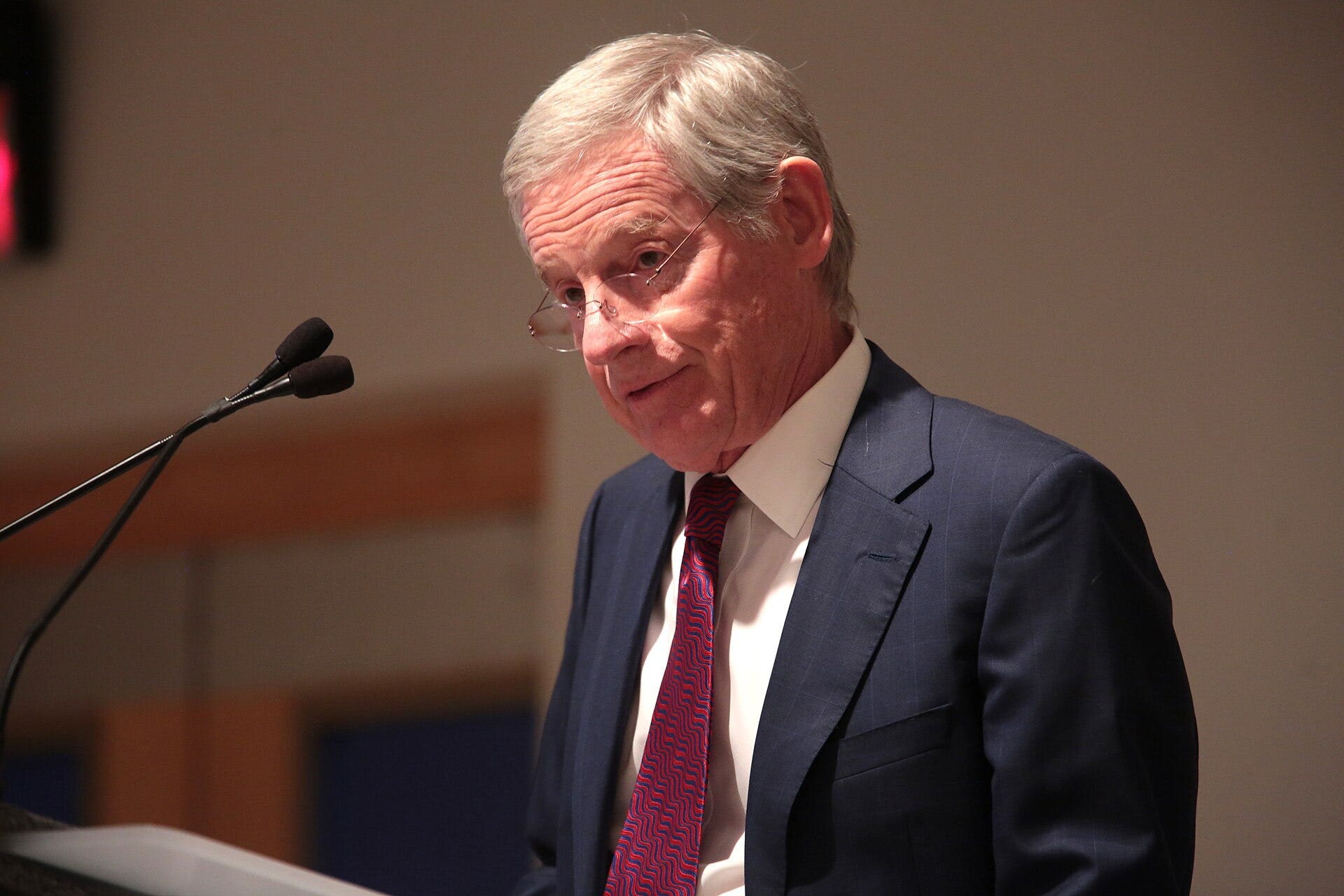

Harvey Mansfield, the William R. Kenan, Jr., Professor of Government emeritus, taught at Harvard for more than six decades, and on September 17th, he returned to the University to say on the record what few professors would: the University needs “a kind of affirmative action” for conservatives.
More specifically, Mansfield affirmed, “a certain coercion needs to be put to the faculty until this happens.” To this end, while he believes that President Trump’s campaign against the University was “in a way, outrageous,” he argued the lawsuits still deserve credit: “I don’t think that the universities would have changed without his intervention, and especially without depriving the universities of large sums of money.”
Mansfield made these remarks at a lunch talk on viewpoint diversity hosted by the Society for the Rule of Law at Harvard Law School, a group of largely conservative and center-right lawyers. Alan Raul — a Harvard Law professor, Reagan-era White House staffer, and the Society’s board president — moderated. The audience was primarily law students, graduate students, faculty, and other affiliates. Indeed, there was a lack of undergraduates in the audience.
Mansfield began with the assertion “viewpoint diversity has no meaning without diversity,” clarifying that diversity was always about viewpoint: “It wasn’t the beauty of ebony skin or of shapely bodies that was behind the use of race and sex [in affirmative action]. It was what black folks and women brought to the community with their lived experience.” The trouble, however, was the society that such a justification produced — namely, “a society of identity, which accuses itself of racism and sexism, which is divided between oppressors and oppressed.” In this sort of society, he posited, “There’s no common good. No spirit of deliberation to search for compromise, only expression of one’s identity.”
Much of the talk turned on the difference between speech and expression. Speech, from the Greek logos, uses reason and addresses a listener. Expression, which Mansfield traced to the landmark 1943 Supreme Court case West Virginia v. Barnette, does not. Yet, Barnette, which considered public school students required to salute the American flag and recite the Pledge of Allegiance, “declared that an act, a salute, a gesture, was a form of speech entitled to First Amendment protection,” Mansfield explained. “This sort of act is not intended to convince, but rather to impress its audience. The expresser advertises himself to the audience.” Thus, with expression, “shouts and slogans are in order.”
Mansfield’s distinction matters because speech and expression are answered differently. Speech tries to convince, so it can be met with a better argument. Expression tries to impress, so it can only be met with more of itself. Thus, a university that treats the two as equal has little ground to keep protest out of the classroom. At last spring’s graduate student strike, picketers circled Sever Hall chanting “If we don’t get it, shut it down!” and for weeks the disruption reached the classroom. Lectures were canceled or moved online, office hours were cut, and sections were combined. Whatever one thinks of the union’s demands, the chanting was not an attempt to persuade anyone but to pressure the University, and students paid for it. Mansfield noted that protest has its place: “The American Revolution began with protest.” But, “Protest speech is inimical to the spirit of a university community, which requires academic freedom. Academic freedom is for the pursuit of truth, not of justice.”
Real viewpoint diversity, he argued, is not simply having both sides represented on campus but having them constantly, meaningfully engage with each other. This is most urgent because of the distinct value commitments of each party. Democrats, according to Mansfield, organize around compassion: “Inclusiveness is what they call for. No one is left out. No one is marginalized. [...] A liberal is one who makes a lifelong search for people to feel sorry for.” Republicans, meanwhile, organize around admiration and desert, the belief that those who contribute more “deserve to have their greater contribution recognized and appreciated. Plumbers should be well-paid for the relief they bring.”
Each value is real, but each is incomplete on its own; compassion without regard for desert can reward those who contribute nothing, and desert without compassion can leave behind those who cannot contribute. In this way, Mansfield insists that the University needs both, “not because free speech is a universal right that both parties should share, but because the two parties need each other for their substance. [...] Neither can rule simply by itself.” Each side keeps the other honest, but only if they argue, if they speak, and certainly not if each side expresses itself, emptily lobbing values at the other. A campus such as Harvard, where progressives tyrannize conservatives, never has that argument, so its values go unchanged.
Notably, Harvard’s official language on viewpoint diversity contrasts with Mansfield’s. The College’s Intellectual Vitality initiative describes itself as founded in “rigor, charity, and open exploration.” Mansfield set a higher, more structured bar, saying viewpoint diversity is about arguments between the parties: “left and right occupy the center,” alluding to the need for the two ideological wings in all discourse. He closed with Henry Rosovsky, whom Mansfield described as “a Harvard authority, the great liberal,” noting “not everything is improved by making it more democratic.”
When Raul asked Mansfield how Harvard might recruit more conservatives, Mansfield responded that Harvard was “much more one-sided even than the city of Cambridge or the state of Massachusetts, to say nothing of the whole country. So we have people from other parts of the U.S. who don’t come from blue states, but mostly they’re blue people, and we could use some of the other type.”
According to Mansfield, this is true even despite the professed nonpartisanship or institutional neutrality of those in leadership: “The partisans presently in charge of Harvard already think they are nonpartisan. They made their decisions and [did] their hiring believing that this was the best person. In some cases, conservatives and Republicans were excluded, either explicitly or implicitly. But on the whole, they [the Harvard administration] don’t see that they’ve done anything wrong. [Harvard] needs to get to a point where it sees that it has done something wrong.”
What is needed, in other words, is affirmative action for identifiable conservatives and Republicans. At this point, Mansfield paused to ask, “Are we off the record now?” Told he was not, he continued: “I’m on the record. I’ve said this. I think a certain coercion needs to be put to the faculty until this happens.”
The University has been attempting some form of this affirmative action in the wake of its funding battle with the Trump administration. Most significantly, Harvard has been quietly asking donors for $10 million gifts to endow professorships under the banner of viewpoint diversity, a campaign led by University Provost John Manning. In a Crimson survey on the matter, 54 percent of current faculty respondents opposed the initiative.
The professorships are not the only change. Two weeks after the administration cut off $2.2 billion in April 2025, Harvard renamed its Office of Equity, Diversity, Inclusion, and Belonging the Office for Community and Campus Life, and ended University funding and space for affinity group Commencement celebrations. Its graduate schools have also since rebranded their own diversity offices, with DEI language across the University giving way to new terms such as pluralism, dialogue, and ideological diversity.
Nor is this the first set of structural shifts that Mansfield has witnessed. Across his nearly seven decades at Harvard, he reflected, the University had changed considerably: all male when he arrived, then the decision “to increase the number of black students, which, by the way, I strongly support,” then feminism, “then the Asians, who, in a way, were the crucial group that killed affirmative action.”
Nevertheless, while Harvard may still seem to be changing, Mansfield’s comments ruffled feathers, and as a microphone circulated for questions from the floor, the audience pushed back.
A self-described liberal was one of the first to speak. He argued that he already hears the conservative perspective in every Supreme Court opinion and presidential statement, and proposed a trade: abolish the Senate and the Electoral College, expand the Supreme Court, and conservatives could pick their share of Harvard’s faculty and students. “You’re a pretty dangerous guy,” Mansfield replied.
Raul redirected, asking whether there were national structural reforms Mansfield himself favored. He offered one: “I would like to go back to capital punishment for obvious murderers. The people who recently killed Charlie Kirk and others, they should be dead now. That would put us in a calmer and more just frame of mind.” Two weeks earlier, a Utah judge had ruled that Tyler Robinson, who has pleaded not guilty, will stand trial for aggravated murder in Kirk’s killing, with the death penalty on the table.
The sharpest exchange came from Randall Kennedy, the Michael R. Klein Professor of Law, who asked whether the call for more conservatives is the right’s version of the campaigns for Black Studies and Women’s Studies. “I wouldn’t deny it,” Mansfield said. “We’re inheriting something as well as opposing something.” The desire for conservatives “is based on rejection of their being slighted, made to feel small, made to feel dishonorable. Politics is much more about honor than about gain.” Mansfield pointed to Harvard’s Department of African and African American Studies, which he said has no black conservative on its faculty: “There are several names one could supply, and which I have supplied, but without effect.”
One last questioner asked whether the whole project fights human nature, since people sort into affinity groups anyway. The stakes, Mansfield said, are squarely scholarly: Harvard social science “tends to be too quantitative and too liberal,” and courses on controversial topics assign readings all on one side. That “isn’t a matter of group feeling, but of how or whether you can learn.” As for nature, he answered, “You are fighting nature if nature consists in identities. But if nature also extends to opinions, it is perfectly natural to want to hear the other side.”
Mansfield is 94. He has been making this argument at Harvard longer than most of his colleagues have been alive. For the first time, the University looks to be acting on it.
Jerry Z. Muller makes a patient, carefully argued case that, in certain circumstances, faculty governance fails and external intervention can be justified, when a department or discipline has been captured by ideology:
https://jerryzmuller.substack.com/p/rethinking-faculty-control
At least a handful of genuinely open-minded academic liberals who are currently in high dudgeon over "assaults on academic freedom" might have their perspective broadened by reading Muller.