

In my last semester at Harvard, I took Introduction to Italian Renaissance Art. We sat in a dark lecture hall on the first day of class. The professor began to flip through slides of Raphael, da Vinci, and Michelangelo, previewing the works we would be studying over the coming months. As the images flashed by, I suddenly felt tears run down my cheeks. I laughed at myself and wiped my tears as I realized: it was the first time in years that I was looking at something beautiful. I felt relieved.
Let me explain.
Over a decade earlier, I had joined my freshman entryway in Sever Hall for the thrilling undergraduate ritual of the icebreaker. The resident advisor asked us to offer our name, hometown, and a fun fact. The best fun fact I could come up with in the moment was that I was vegan (which, in retrospect, was probably highly annoying).
In the middle of the icebreaker, one female student mentioned that her pronouns were “she/her/hers.” Another student innocently asked why she mentioned it; she replied, “That’s just how I identify.” I exchanged an amused and mildly confused glance with the student next to me. For the rest of my first semester, pronouns never came up again.
My first stretch at Harvard would only last one semester, however—I was recruited to continue my professional ballet career, and I decided to take an indefinite leave of absence. Ballet had been my life’s purpose; Harvard could wait. I did not know that it would be nearly a decade before I would return to campus. By the time I came back ten years later, Harvard had become nearly unrecognizable.
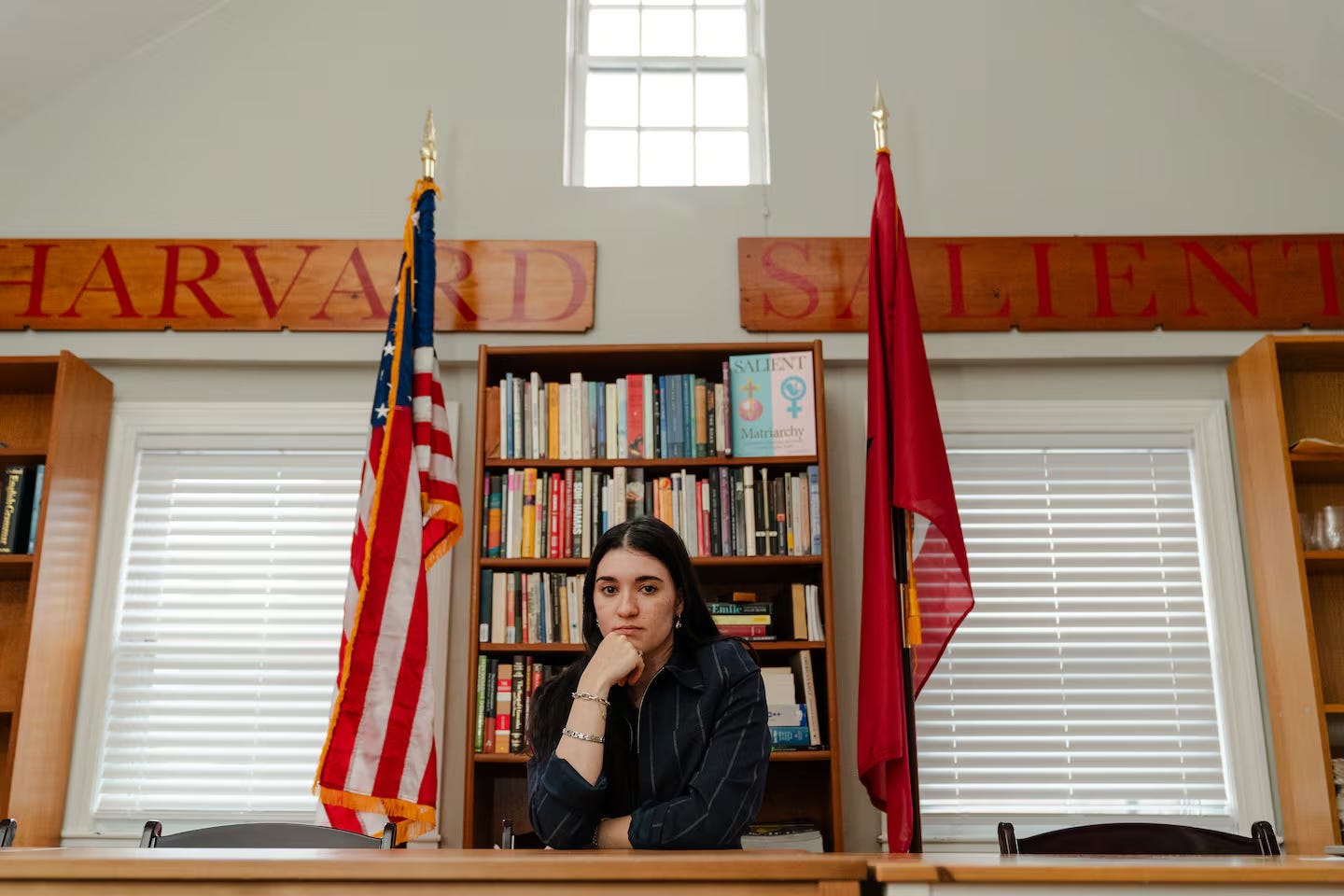
When I returned in 2023, I was shocked to find that there were hundreds of new ways to accidentally offend the student sitting next to me. Class discussions were stifled and awkward. FIRE’s free speech rankings ranked Harvard dead last, even as the newly-installed President Claudine Gay boasted of Harvard’s “courage” to “love the truth enough to ask Why?”
In conversations with my new peers, I searched for subtle signs of conservatism—do they wear a cross? Do they skip over pronouns during the icebreaker? In the aftermath of October 7th, I reeled from the notion that my classmates could genuinely think massacring Jews was a form of justified resistance. That thought alone captured the new reality of Harvard’s campus: political discussions were no longer disagreements on the facts, but rather indications of differences in students’ basic morality.
My experience was not a coincidence—the mid-2010s marked the beginning of a large-scale change on Harvard’s campus. In his recent Compact essay, “Why I’m Leaving Harvard,” James Hankins states that it has been a decade since Harvard last hired a tenured historian to teach Western Civilization. Theda Skocpol noted in an interview in December that Harvard had gone “too far…for a decade.” Jacob Savage’s impressive compilation of DEI discrimination cites 2014 as “the hinge” year when “DEI became institutionalized across American life.”
The wrongness of it all struck me long before I could explain it intellectually. My background had been in the arts, where beauty is always self-evident. A ballet performance either strikes you as beautiful, or it doesn’t. Just like beauty, which I knew I could recognize, truth should be instantly recognizable. Watching my peers on campus struggle with basic truths like “terrorism is evil” felt ugly. Even though I had not yet read much of the conservative canon, I knew something at Harvard had gone deeply wrong.
When I joined the Salient, I found relief in a team of students who not only shared my politics, but also understood the difference between good and evil. While scandal engulfed Harvard, the Salient, a parallel campus institution, only grew—we became less of a publication and more of a counter-cultural hub of American patriotism and open inquiry.
The entire student team rolled up their sleeves. We worked with conservative student groups across the University to independently host the Conservative & Republican Student Conference in Harvard Square. Nearly 300 students attended to hear congressmen, ambassadors, think-tank leaders, and entrepreneurs debate the future of conservatism.
We recognized that we needed a stronger presence in the broader conservative movement to grow our operations on campus, so we started a podcast and revamped our Substack, thereby doubling the Salient’s coffers. When the Salient was barred from distributing to student dorms, we successfully lobbied the College to guarantee distribution rights for all print publications on campus. We expanded our office space and flew an American flag proudly above our front door. Membership grew, debate was robust, and I passed the torch to my successor with great hope.
What I did not anticipate was how some on the right would capitulate to the same rot that we had been fighting against. After a decade of contending with DEI orthodoxy, activist professors, and many openly hostile peers, some ‘conservative’ students began to agree that the very idea of persuasion was obsolete.
In effect, ‘right-wing’ students devolved into the same woke scolding they claimed to abhor. Claudine Gay’s “courage to ask Why” had become “just asking questions” about absurd conspiracies. While their labels differed, the emotional impulse was the same: a grievance-based mission for total control. Coercion, in some students’ minds, had replaced conversation as the new conservative ideal.
And yet, when the Salient sought to persuade, we succeeded extraordinarily. We proved that when faced with genuine grievances, conservative students could not just fix our own problems but also make our campus better for everyone by doing so. Today, the Salient is a model for conservatism that is driven by principle and persuasion—not because persuasion is polite, but because it is the only alternative to becoming morally indistinguishable from the intolerant orthodoxy we seek to overturn.
The Salient’s task is formidable. Harvard, an institution nominally dedicated to truth, has lost its reflex for recognizing self-evident truths. As long as discourse is dismissed as ineffectual, vengefulness will continue its reign. Harvard’s administration chose relativism; the fringe right chose resentment.
The Salient will always choose Veritas.
But persuasion only works if the truth is known and felt. Having seen Harvard in both 2014 and 2024, I know that Harvard has lost its ability to discern the truth. And in that art lecture, I was overwhelmed by that loss. After more than two years with my head in a political toilet, spending all my time either studying politics or navigating campus politics, it was beauty that brought me the relief that I didn’t even know I needed.
As I graduate, I am proud to have defended a conservatism that pursues truth, recognizes beauty, and reveres the art of persuasion.
Godspeed, Salient team. It’s been my greatest privilege.
Sarah Steele is President Emerita of the Harvard Salient and a mid-year graduate of the Class of 2025.
So beautifully said. Thank you! Godspeed on your life's journey.
Thank you, Sarah, and The Salient. Your story aligns with many in our book, Finding God at Harvard. And the sequel (my story). And the Veritas Forums in which I'd bring truth-seekers like you together. Grateful for this profound essay!