

Over the past decade, young Americans rapidly radicalized. The percentage of young adults supportive of political violence has reached a historic apex, and anti-Semitism among the youth is more common than at any other time in American history.At Harvard, even supposedly mainstream institutions are entertaining extremism. In a recent Crimson column, a writer stated that it was morally neutral to refuse to be friends with “Zionists,” that is, those who believe there should even exist a Jewish state (a view that is for many Orthodox Jews a central tenet of their faith). The previous president of the Harvard Republican Club also previously chaired the now fringe John Adams Society during its own period of radicalization, where he allegedly presided over Nazi salutes during meetings and the expulsion of women. Broader cultural trends likely explain some of this phenomenon, but at Harvard, an institution of putatively rational people, radicalism likely has an intellectual rationale, too. So, then, why are young Ivy Leaguers falling for extremist ideologies, and how can we combat this trend?
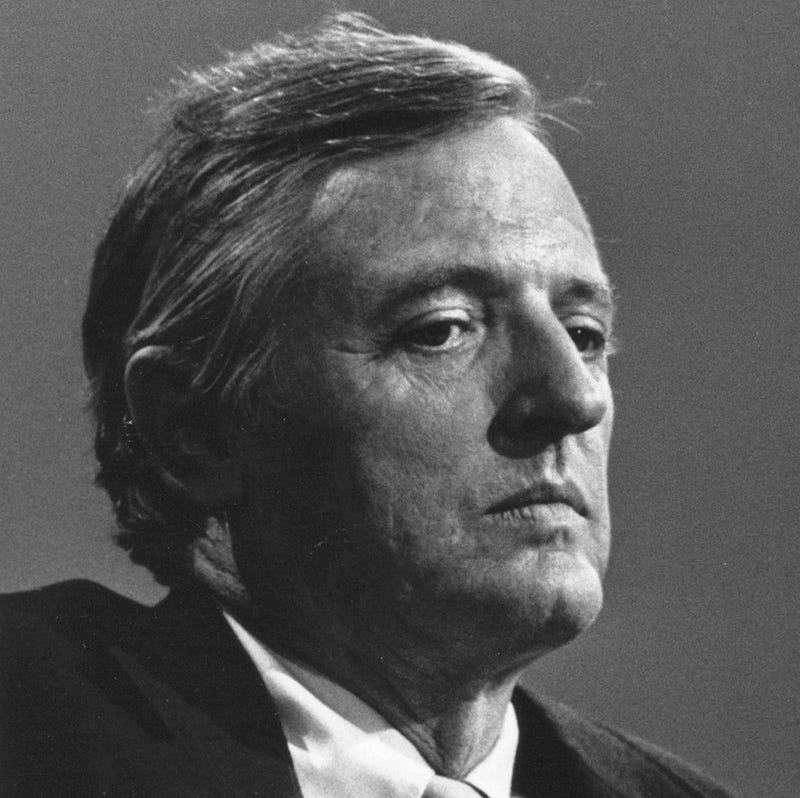
The story of William F. Buckley Jr., the founder of National Review and longtime leader of the modern American conservative movement, offers an instructive example of both radicalization and de-radicalization. As a young man in the 1940s, Buckley’s attitude toward segregation was standard among moderate Northerners: while segregation was wrong, desegregation would require time. Young Buckley, in particular, believed this because he thought that, due to an absence of educational opportunities, Southern black people were “less advanced,” and thus, their votes would be determined by “passions.”1 While this view was incorrect, it was not necessarily racist; indeed, Buckley always qualified his statements on segregation with the recognition that differences between Southern blacks and whites were “environmental and not racial.”2
As decolonization movements succeeded internationally, however, Buckley’s defense of segregation became more extreme. In the late 1950s, Buckley declared that segregation was not just necessary but right—and that employing violence to defend it was therefore justifiable. Following the success of the decolonization movement in the Congo, Buckley’s rhetoric became actively racist, declaring the necessity of a “race war” to defend “civilization” against “Black Madness.”3 Buckley’s reasonable conservatism had been replaced with overtly racist radicalism.
Yet, some time during the mid-1960s, Buckley deradicalized. Central to this shift seems to have been the rise of populist politicians in the South who defined themselves by their racism. Buckley’s contempt for these politicians was unusually extreme, given that he was otherwise politically aligned with them. He described Alabama governor George Wallace’s rhetoric of “racial integrity” as “galvaniz[ing] the demon” who committed the 1963 Birmingham bombings, Georgia governor Lester Maddox’s discrimination against black people as “morally inexplicable,” and Southern politicians opposed to expanding the franchise to black Americans as “primitives.” Seemingly driven by disdain, Buckley eventually became unusually vocal in his support of civil rights among conservatives of his day. He said there was “no moral” reason why black people should be unable to vote, approvingly compared desegregation to de-Nazification, praised civil rights leaders such as Bayard Rustin, and repeatedly obstructed attempts to bring racists like Wallace into the conservative movement.4 Buckley had not just rejected his previous views; he had rightly become a committed egalitarian.
At first glance, Buckley’s evolution seems strange. Both Buckley’s radicalization and subsequent deradicalization were rapid and irrational. It was odd that after explicitly rejecting racism, young Buckley came to advocate for race war during conflict in the Congo. Similarly odd was Buckley’s subsequent disdain for politicians advocating the segregation he often defended. Condemning these changes as cynical attempts to mimic public opinion, however, would be too quick a judgment—Buckley’s bigoted racial radicalism was unusual in the 1950s among Northern conservatives, causing public ire even from his own family members, while his later views antagonized many significant players in the conservative movement who viewed Southern racists as natural allies to conservative Northerners.5
Joseph Heath’s concept of “self-radicalizing views” can help us better understand Buckley’s confusing ideological journey. Heath examined the Marxist methodology of “ideology analysis,” which asserts that when people act in contradiction to their materialist “interests” (as defined by Marxism), it is because they have been duped by “ideologies” which have (incorrectly) convinced them that they have other interests. For instance, feminist theorists often argue that the reason why women continue to purchase cosmetics that perpetuate traditional gender roles is because women have been duped into believing that their outward appearance is the primary source of their personal worth.6
However, Heath points out a problem with ideology analysis, that it resists falsification. If people do not respond to their “ideology” being identified and rebutted by immediately enacting Marxism, then, rather than recognizing ideology analysis’ explanatory failure, analyzers can instead claim that there must be some \textit{even deeper }ideology to blame. For instance, when feminists like Naomi Wolf found that women often did understand the negative ramifications of the cosmetics market yet nevertheless still purchased cosmetics, she argued that ideology had so permeated women’s lives that they were affected by an “unconscious hallucination,” something that duped them on such a fundamental level that women’s lives resemble those of people who live in “a cult.” Worryingly, as this example shows, when ideology analysis fails to explain agents’ actions, the analyzer is led into a cycle of self-radicalization, in which they continually “discover” some “deeper” and more universal ideology underlying agents’ actions, one which the agents are not privy to, until their theory loses any tether to reality.7
Buckley faced a similar self-radicalizing cycle. By assuming that less educated black areas sought political change only because they were duped by their personal emotions, Buckley was, at first, able to reject desegregation without relying on racial essentialism. As civil rights and decolonial movements became global phenomena, Buckley’s view was falsified—it couldn’t be that each and every instance of black political action had the same misguided emotions behind it. Buckley could only salvage his view through a self-radicalizing escape hatch—racism. If all black people had some common irrational passions by virtue of their race, then Buckley’s methodology still seemingly worked. Thus, race now had to play a central role in Buckley’s explanation for the civil rights movement. In this explanation, Buckley’s radicalization resulted from a similar self-radicalizing spiral as that faced by Marxist ideology analysts.
Heath’s critique also helps us understand how Buckley de-radicalized, not by discovering an argument or a piece of knowledge but rather by reevaluating what the conclusion of his spiral would be. The views Buckley had held and the race war for which he had advocated were purely theoretical, maintaining a careful distance from practical politics. But what Buckley had advocated for theoretically entailed much of the demagogic, punitive policy of the populists he condemned. It is difficult not to read self-criticism, for instance, into Buckley’s condemnation of George Wallace for how his “galvanizing” rhetoric of “racial integrity” bred terrorism. After all, Buckley’s rhetoric from the same period was just as incendiary, only using more intellectual terminology. Many of those populists whom Buckley condemned, it seems, faced the same radicalizing spiral as Buckley—they were just further along that spiral. Seeing the endpoint he would have faced if he did not recognize the insufficiency of his explanatory tools in time was what ultimately resulted in Buckley’s moral redemption.
We can therefore see how we may enable de-radicalization for those enmeshed in modern radical movements, as well. By observing the evils of the most extreme, those on the long roads to right or left-wing extremes may be able to take heed and reconsider their trajectory and assumptions.
Take, for instance, the Harvard Crimeson, a radical pro-Palestine imitator of the Crimson. Founded on the idea that Harvard is a member of a “colonial” conspiracy that has implicated itself with Israel, the Crimeson may have seemed like it had little capacity for further radicalization. That has not stopped them in their transformation from a merely conspiratorial fringe group to a completely crazed one. The Crimeson, assuming that “Zionists” are always motivated by a malicious, unified colonial conspiracy, is forced to explain how many different sorts of people with many different interests converge at Zionism. They have responded by alleging a worldwide Zionist project that controls every injustice, from Latin American dictatorships to war in the Indian subcontinent, and that self-interestedly supports every major institution, from major corporations to our very own Crimson. Just as Buckley came to see every black person as motivated by evil, so the Crimeson has come to see every “Zionist” as driven by an international colonial conspiracy.
If this all sounds a little ridiculous, that’s because it is. College-level extremism is ridiculous. While these people may become dangerous in the future, for now, they are just fanatics willing to take any position in order to avoid admitting error. Thus, even though the rhetoric of fringe groups like the Crimeson is corrosive, their presence on campus might well be additive. The self-radicalizing assumptions that the Crimeson fell prey to, in assuming that any disagreement over Israel must be motivated by malice or self-interest, can hopefully allow more well-adjusted students to recognize the dangers that result from assuming that one’s ideological opponents must be either ill-natured or mentally ill.
At a school where many seem to think—as the President of the real Crimson has argued—that anyone who dissents from the “correct” political views (which they have somehow easily discovered by age 18) is “[un]deserving of merit and consideration,” that students ought not befriend those who have committed the crime of disagreement, and that the school ought not “platform heterodox positions,” these negative examples can de-radicalize campus. When the Salient faces intolerance, we reject it. Hopefully the paper of the left at Harvard has the same principles.
So, when it comes to the fringe, whether the far-left or the far-right, let a thousand blossoms bloom. For those of us in the mainstream, if bigots like to emit ignorant bile, it is to our benefit. Their behavior helps us see clearly the intellectual mistakes to which even the supposedly thoughtful can fall prey.
Felzenberg, Alvin S. A Man and His Presidents: The Political Life of William F. Buckley Jr. Yale University Press, 2018, pp. 81-2.
Curtis, Jesse. “‘Will the jungle take over?’ National Review and the defense of Western Civilization in the era of civil rights and African decolonization.” Journal of American Studies, vol. 53, no. 4, 9 May 2018, pp. 997–1023, https://doi.org/10.1017/s0021875818000488, p. 13.
Curtis, Jesse. “‘Will the jungle take over?’ National Review and the defense of Western Civilization in the era of civil rights and African decolonization.” Journal of American Studies, vol. 53, no. 4, 9 May 2018, pp. 997–1023, https://doi.org/10.1017/s0021875818000488, pp. 20-3.
Felzenberg, Alvin S. A Man and His Presidents: The Political Life of William F. Buckley Jr. Yale University Press, 2018, pp. 79-80.
Felzenberg, Alvin S. A Man and His Presidents: The Political Life of William F. Buckley Jr. Yale University Press, 2018, pp. 121, 157-60, 205-6, 244-5.
Felzenberg, Alvin S. A Man and His Presidents: The Political Life of William F. Buckley Jr. Yale University Press, 2018, pp. 80–1, 245.
Heath, Joseph. “Problems in the theory of ideology.” Pluralism and the Pragmatic Turn, 4 Sept. 2001, pp. 163–190, https://doi.org/10.7551/mitpress/5425.003.0010, p. 173.
Heath, Joseph. “Problems in the theory of ideology.” Pluralism and the Pragmatic Turn, 4 Sept. 2001, pp. 163–190, https://doi.org/10.7551/mitpress/5425.003.0010.
Tolerance for people of different religions, races, ethnicities, nationality, and groups is a worthy goal for Americans to strive for and uphold.
One must be careful, however, not to overshoot the mark.
Where it becomes problematic is where the promotion of group members is elevated to the point where it interferes so much with the operation of the economy that it weighs down the living standards of the nation, the quality of goods and services, and the kind of economic growth that is necessary to spread prosperity to as many people as possible.
High taxation, for example, in the name of promoting tolerance of immigrants who abuse social programs (think Somali fraudsters in Minnesota) is counter productive. The economics of such abused social programs are clearly faulty, and perhaps even more worrisome is the psychological effect on such groups who develop a sense of entitlement based on their immigrant status, their Islamic religion, or their skin color. These people become lazy and dependent on the government. They contribute nothing but lies on government forms to the economic growth that is needed to support them in the first place.
Moreover, simply pointing this out should not place me into some sort of negatively-tagged stereotypical category such as "far right," "White Supremecist," "right wing extremist," or "Nazi." If it does, then you know for sure that tolerance has overshot the mark.
Dr. Ben Carson became one of the world's best neurosurgeons at John's Hopkins, not because he was black, but rather because he worked very hard and became a good neurosurgeon. His contribution to the economy was not lies on government forms, but rather extremely rare surgical skills that saved and extended lives!
Dr. Ben Carson rose up based on the content of his character, not the color of his skin.
https://en.wikipedia.org/wiki/Ben_Carson
Your disdain for radicalism is interesting, as if you worship the middle of any two points. What is radical in one culture or context might be mainstream in another.
You seem to be overgeneralizing. The issue is not radicalization, but what is right, true, and just.
For instance, is it right or wrong to murder? One radical extreme is likely more adherent to truth and justice than the other.
Recall, the American Revolution was about as radical as it got, at the time.