

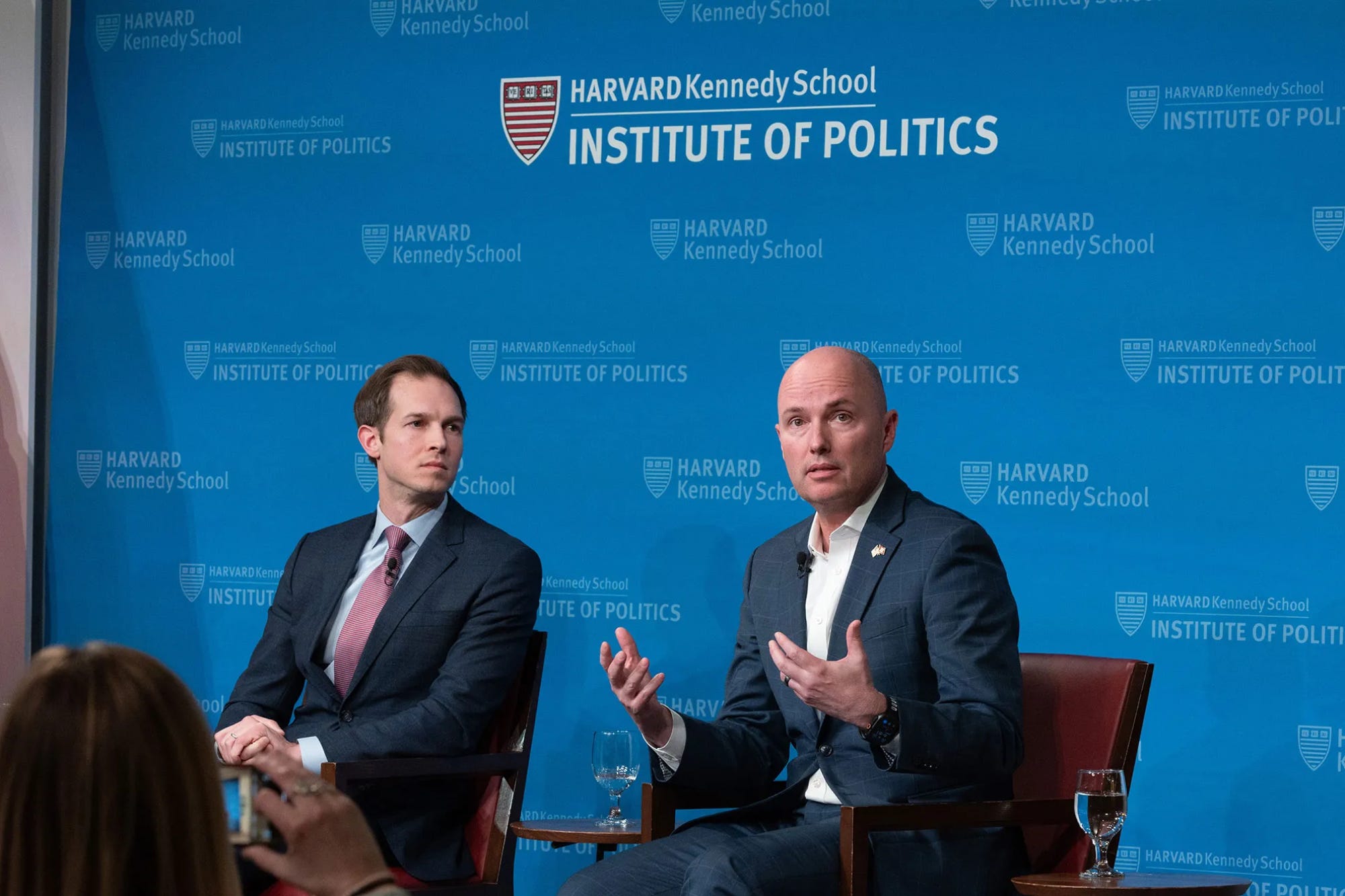
Governor Spencer Cox (R-UT) and Congressman Jake Auchincloss (D-MA) discussed the role of social media in political polarization in the first John F. Kennedy Jr. Forum of the semester. While the topic did not spark open disagreement, the Democratic Congressman repeatedly referenced ICE and the Trump administration; his comments suggested that even in spaces nominally dedicated to bipartisanship, the left feels justified in imposing their agenda. Moreover, despite Auchincloss’ appeal for greater restrictions on social media use, Governor Cox’s recognition of the necessity for broader cultural renewal demonstrated that he alone grasped the full nature of the problem.
Governor Maura Healey (D-MA) gave the opening remarks. She called attention to the dire situation surrounding social media and youth in our country: specifically, the threat that the use of artificial intelligence and social media poses to mental health. Healey noted that she believed Donald Trump’s presidential administration was “part of the problem,” referencing Trump’s use of AI in social media posts. Both Healey and Cox have introduced legislation with guardrails on social media for youth, framing it as a public health issue similar to alcohol and tobacco usage.
Congressman Auchincloss blamed widespread acceptance of political violence on social media, arguing that its algorithms have led Americans to lose hope in a shared future. Despite his concern, however, he did not provide a compelling alternative to his pessimistic vision; while we can attempt to restrict social media, repairing the rifts it has generated requires a positive alternative. Moreover, while acknowledging the need for reform, Auchincloss’ comments suggested that his priorities lay elsewhere. “We’re all paying attention to the same thing,” he said with regard to social media, “isn’t that a nice feeling? [...] To be in an experience with other people, and it’s the absolute most potent force against proto-fascism.” It is ironic that in a panel discussion on the dangers of political polarization, Auchincloss felt comfortable celebrating it.
Governor Cox’s comments, however, reflected a genuinely bipartisan skepticism towards the polarizing effects of social media. “We don’t have any real friends,” he said, “but we can hate the same people on social media together.” Governor Cox argued that social media has replaced the religious activity that took up the recreational hours of our predecessors; the acceptance of political violence stems not only from social media use, he argued, but also from the loss of religious activity which social media has replaced.
While the bipartisan focus on social media is admirable, the necessity of government-imposed restrictions reveals a deeper flaw in our society. A culture with strong values does not require the government to play a significant role in the lives of children; instead, parents take responsibility for their children’s moral and intellectual development. Values, in other words, should not have to be imposed from the top down. The fact that there was no mention of parents’ role in monitoring children’s social media use suggests that we have lost the moral strength required to build a healthy society. A society that views the government as the proper steward of child development has departed from the traditional values that ought to hold it together. While neither politician identified this problem, Governor Cox recognized that restrictive policies alone cannot repair a society that has lost its moral standing. This recognition is significant, for only by acknowledging its own limitations can the government work with Americans to build a stronger society.
Hello! Parent here. In principle I agree that parents should be the primary moralizing force for children, however, in the rancid cultural ecosytem we have, it's almost impossible for children to grow up healthy. I was by far the most restrictive parent I knew about the internet and social media. Our daughter did not get it until she graduated from high school. Our son got it in high school, but with multiple layers of monitoring and minimal time limits. But, they see it on their friends phones, they hear other kids talk about a warped set of values, they hear vulgarity broadcast in public places. Make no mistake, the government needs to clamp down on the companies that engineered a system that hijacks brains. Even the most intentional parenting has difficulty resonating when kids hear a million messages each day that tell them what their parents say is just not true. Parents in the past could count on neighbors, fellow parishioners, teachers, all echoing the same basic ethos. That is no more. In previous generations a kid alone in the backyard or bathroom was largely out of harms way- now immoral and dangerous messaging has deep access to our kids, even with the best protections parents can find.
This kind of writing is better than previous writings i’ve read from the Salient since the schism. More of this please, and don’t hold back!