

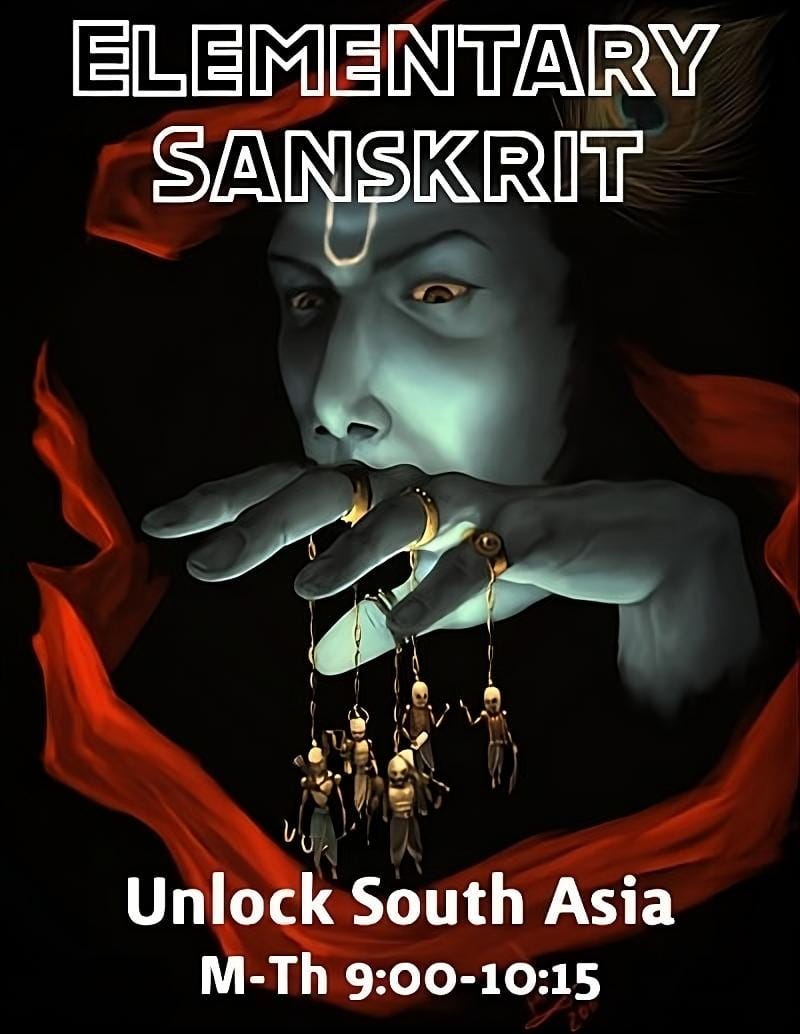
The recent removal of an image from the website of Harvard’s Department of South Asian Studies, following a coordinated pressure campaign by the Coalition of Hindus of North America (CoHNA), may seem like just another case of administrative oversensitivity, of wokeness gone wild. But it was not just that. Rather, it was a skirmish in an ongoing campaign of institutional capture. While administrators likely viewed their groveling apology for the “insensitive image” as a routine exercise in “inclusive” self-criticism, they unwittingly facilitated a movement that is fundamentally anti-American, segregationist in spirit, and strategically deceptive. In particular, Harvard has failed its Hindus by redefining their faith in the image of a bigoted, fringe movement.
To understand why the South Asian Department took down this fundamentally innocent image, we have to understand the CoHNA, the organization that pressured them. At first, the CoHNA seems to hold an incoherent ideology. The lobby simultaneously uses both woke and anti-woke arguments. In their official communications, CoHNA and the Hindu American Foundation (HAF) have begun characterizing protections from discrimination based upon the feudal caste system as “misguided and excessive DEI initiatives.” They have mastered a form of rhetorical ventriloquism, using conservative buzzwords like “woke” and “cancel culture” to characterize criticism of caste discrimination, a form of racial discrimination inimical to American values, as a form of social justice overreach.
At the same time, however, the CoHNA uses dishonest, left-wing “decolonial” rhetoric, arguing that the caste system is a “Colonial Invention.” In their official literature, CoHNA claims that caste is a 16th-century Iberian import and that British census administrators froze a “previously fluid” society into a rigid hierarchy. This argument is strategically designed to shift the moral burden of 2,000 years of social exclusion onto the shoulders of dead British ethnographers, framing any contemporary legal protection against caste as a form of “neo-colonialism.”
Of course, this “blame the West first” rhetoric ignores the millennia of Caste discrimination built into feudal Hindu theology. In the historic works of Brahminism, discrimination is a matter of theology. This theocratic view is rooted in the Purusha Sukta of the Rig Veda (10.90.12), which explicitly codifies a cosmic hierarchy: “The Brahman was his mouth, of both his arms was the Rajanya [Kshatriya] made. His thighs became the Vaishya, from his feet the Shudra was produced.”1
This is not a misunderstood metaphor; it is a claim of inherent, ethnic hierarchy. The Manusmriti, the primary law book of this tradition, elevates the Brahmin to the status of a terrestrial deity: “A Brahmin, be he ignorant or learned, is a great divinity.”2 This “great divinity” status dictates that the high-born possess an immutable right to rule over the “foot-born,” whom the text describes as created solely to be the slaves of the Brahmin. The text mandates, “But a Shudra, whether bought or unbought, [a Brahmin] may compel to do servile work; for he was created by the Self-existent (the Creator) solely to be the slave of the Brahmin.”3 By defining this servitude as a cosmic design rather than an economic contract, the theology ensures the hierarchy is inescapable, concluding that “a Shudra, though emancipated by his master, is not released from servitude; since that is innate in him, who can set him free from it?”4
Considering this history, the internal contradictions of the CoHNA’s argument on caste are profound. CoHNA blames the British for the rigidity of the system, yet they continue to defend the exact Brahminist theology of “Varna and Jati” that gives the system its power. By claiming that Brahminist India was a flexible, spiritual setup while defending a theology that birth-locks social status, the CoHNA is playing a semantic shell game. They cannot explain why a fluid system produced centuries of documented discrimination against ethnic “untouchables” long before the first British ships arrived.5 They are effectively arguing that the British built the cage, but the bars of the theology are nevertheless divine and must be respected. Their radical, outdated theology is a direct assault on American meritocracy, demanding that the U.S. legal system grant immunity to ethnicity-based discrimination under the guise of religious freedom. Their identification of this ideology with Hinduism is also a misrepresentation of American Hindus, the vast majority of whom reject Medieval Brahminist theology.
Nothing illustrates the CoHNA’s ability to manipulate American institutions better than the quiet closure of the Department of Justice (DOJ) investigation into the BAPS Swaminarayan temple in New Jersey in September 2025. Federal authorities ended a four-year probe into allegations that the organization used forced labor, specifically low-caste workers, to build a massive stone temple for just $1.20 an hour. After one worker died on the temple site and another died right after returning to India, the FBI raided the compound in 2021. They discovered workers allegedly confined to a “guarded compound.” Soon, the case expanded as similar practices were found at other BAPS sites in California, Illinois, Texas, and Georgia. Since then, the DOJ’s decision to close the case has been declared by the CoHNA as “proof” that the allegations were a “campaign of calumny.”
The closure of the case is deeply suspicious. In July 2023, 12 of the 21 plaintiffs withdrew from the civil lawsuit, claiming through a new attorney that they had never experienced “any pressure, any casteism or discrimination” and alleging that their previous lawyers had “convinced them to make false allegations in court.” The radical Brahminist lobby has repackaged this claim of legal coercion as a moral victory, successfully framing the state’s inability to prosecute as a complete exoneration of the labor structures that built the largest Hindu temple in the West. This isn’t justice; it is the strategic rebranding of $1.20-an-hour manual labor as a “religious practice” that conveniently exempts institutions from the Fair Labor Standards Act. By arguing that the Department of Labor misunderstood a core Hindu religious practice as a secular labor violation, the CoHNA successfully weaponized religious terminology to mask the same structures of birth-locked servitude documented in the Manusmriti.
This theocratic movement does not just ask for apologies; it buys policy through a sophisticated network of Political Action Committees (PACs) targeting the highest levels of American government. The Hindu American PAC and its affiliates have funneled millions into the campaign coffers of a bi-partisan group of lawmakers to ensure that Brahminist hereditary status remains unregulated.
The most egregious example of this influence was the 2023 veto of SB 403 in California. This bill was a common-sense civil rights measure designed to explicitly ban caste discrimination. However, the Brahminist lobby launched a scorched-earth campaign, framing equality as a tool to “profile Hindu Americans.” Through relentless donor pressure, they successfully coerced Governor Gavin Newsom into striking down the bill. At this moment, a major American governor and likely future Presidential contender chose to protect an ancient, exclusionary hierarchy over the civil rights of laborers in order to satisfy a theocratic donor class that rejects American values. The radical Brahminist veto has not stopped there. A recent bill designed to stop the Indian government from targeting religious refugees from India with violence was vetoed by Newsom, as well, partially due to CoHNA pressure. This is the end goal for the CoHNA and similar theocratic organizations—an America that cannot defend itself or its citizens from foreign governments for fear of perceived offensiveness.
Once we look past the CoHNA’s flashy PR and understand their actual goal, their apoplectic reaction to the puppetmaster image makes sense. When groups like the CoHNA declare themselves victims of Hinduphobia at the sight of a high-caste figure pulling strings, the CoHNA is likely not expressing offense but seemingly seeking to silence dissent. Proponents of radical Brahminism like the CoHNA paradoxically claim to be, by their very DNA, divine and superior while demanding safe spaces from the basic rigors of the academy. By allowing CoHNA to dictate the limits of imagery on an academic website, Harvard has chosen to allow this bigoted fringe to redefine Hinduism according to a Medieval, radical understanding. Therefore, by placing the power dynamics of historic Hinduism beyond the reach of scrutiny, Harvard has failed us all.
Harvard’s motto is Veritas, not Veneratio. Our job is to seek truth rather than to perform acts of social media groveling to appease a radical fringe that views entire ethnicities as natural slaves. The radical Brahminist movement is anti-American to its core, seeking to replace the meritocratic individual with the hereditary caste. The American experiment is built on the Enlightenment conviction that all men are created equal and that we are judged by our character rather than our bloodline. We cannot forget that because some people might find liberty or equality “offensive.”
By caving to the demands of the radical Brahminist lobby, the South Asian Department has signaled that Harvard is no longer a sanctuary for truth but rather a soft target for a racist fringe. It has further signaled that it will not defend the Hindu faith against the outdated and extreme misunderstandings which fringe Brahminist organizations seek to codify. It is time for us as Harvard affiliates and Americans to cut the strings of this puppetmaster.
The Rigveda: The Earliest Religious Poetry of India, trans. Stephanie W. Jamison and Joel P. Brereton (New York: Oxford University Press, 2014), 3:1538–39 (10.90.12).
The Law Code of Manu, trans. Patrick Olivelle (New York: Oxford University Press, 2004), 218 (9.317).
Olivelle, The Law Code of Manu, 190 (8.413).
Olivelle, The Law Code of Manu, 190 (8.414).
Anthony, Remalli. “Untouchability and caste discrimination in India: A historical perspective on reservation policies.” International Journal of Education Humanities and Social Science, vol. 07, no. 06, 2024, pp. 21–35, https://doi.org/10.54922/ijehss.2024.0832.
As CoHNA, we reject the caricatures of Hindus as a “bigoted fringe.”
Harvard itself removed the ghoulish image and apologized for insensitivity.
The BAPS case closed in Sept 2025 with zero charges after 4 years of DOJ/FBI probe and the opposition SB403 because U.S. laws already ban discrimination by ancestry/ethnicity; Gov. Newsom agreed.
The article misreads Manusmriti and Purusha Sukta, the British colonial census hardened what was fluid. Many tropes in it echo 19th-century colonialism.
Let’s debate with Veritas, not recycled stereotypes.
Read our Dalit and Bahujan Leaders respond https://cohnaofficial.substack.com/p/not-so-salient-the-caste-police-strikes
This article's central claim collapses on its own opening image. The artwork, "Master of Puppets," was created by Anirudh Sainath (Molee Art), a devout Hindu digital artist, as cover art for his father's book on spirituality. The figure is not "a high-caste figure pulling strings." It is Śrī Kṛṣṇa — God — depicted as the sūtradhāra, the divine puppeteer of the five Pāṇḍavas, a deeply reverential bhakti image rooted in the Gītā (18.61: the Lord dwells in the hearts of all beings, causing them to revolve as if mounted on a machine). The five "marionettes" are Yudhiṣṭhira, Bhīma, Arjuna, Nakula, and Sahadeva. The authors saw a tilak and assumed "Brahmin pulling strings." They mistook God for a caste group. That's the level of theological literacy driving this piece.
The textual case is worse. The article quotes Ṛg Veda 10.90.12 (the Puruṣa Sūkta) and declares it "not a misunderstood metaphor" but "a claim of inherent, ethnic hierarchy." The Puruṣa Sūkta is a cosmogonic hymn describing the entire universe — sun, moon, animals, the Vedas, the cardinal directions — emerging from the sacrifice of the cosmic Puruṣa. Isolating one verse about social groups from a hymn about the origin of the physical cosmos is a basic exegetical error. More importantly, this is the ONLY hymn in the entire Ṛg Veda mentioning a fourfold division. The word "śūdra" appears exactly once in 10,600+ verses. If the varṇa system were the foundation of Vedic religion, its near-total absence from the rest of the Ṛg Veda would be inexplicable.
Meanwhile, the Ṛg Veda itself shows fluidity. In 9.112, the poet says: "I am a poet, my father is a physician, my mother grinds grain." Multiple occupations, one family, no hint of birth-locked status. Kavaṣa Ailūṣa, a Ṛg Vedic ṛṣi, was the son of a dāsī (slave woman). Viśvāmitra was born a Kṣatriya king and became a brahmarṣi through tapas — impossible under a rigid birth-based system.
The article calls the Manusmṛti "the primary law book of this tradition." It is one of 20+ Dharmaśāstra texts whose authority has been contested within Hinduism for centuries. Ambedkar publicly burned it in 1927 — celebrated by Hindu reformers, not condemned as heresy — because Hinduism has no single binding legal code. The Bhagavad Gītā (4.13) says varṇa is based on guṇa and karma, not birth. The Bhāgavata Purāṇa (7.11.35) says a person's varṇa should be determined by conduct, not lineage. And in the Mahābhārata's Vana Parva (3.177-178) — the very epic whose characters are in the artwork — Yudhiṣṭhira is asked directly, "Who is a Brāhmaṇa?" He answers: conduct alone determines status. If a Śūdra has noble qualities, he is a Brāhmaṇa; if a Brāhmaṇa lacks them, he is a Śūdra. "Na yoniḥ nāpi saṃskāro na śrutaṁ na ca saṁtatiḥ / kāraṇāni dvijatvasya vṛttam eva tu kāraṇam" — neither birth, nor saṃskāra, nor learning, nor lineage is the mark; conduct alone is. That's Dharmarāja himself speaking in the text Hindus call the fifth Veda.
The method here — cherry-picking the harshest legal texts and declaring them the essence of a religion — could destroy any tradition. Leviticus 25:44-46 authorizes hereditary slavery. Exodus 21:20-21 says a master who beats a slave is unpunished if the slave survives a day because "the slave is his money." 1 Samuel 15:3 commands the slaughter of infants. Ephesians 6:5 tells slaves to obey masters "with fear and trembling." Quran 4:3 and 4:24 permit taking slave women as concubines. Surah 9:5 instructs: "Kill the polytheists wherever you find them." Classical fiqh codified slave markets across all four madhāhib.
No serious person reduces Christianity to Leviticus or Islam to Surah 9:5. These are traditions of billions, defined by their spiritual and ethical cores, not by their harshest ancient legal texts. The same courtesy is owed to Hinduism. And defending a community against reductive bigotry is not endorsing historical texts. CAIR opposing Islamophobia doesn't mean endorsing jihad. Jewish groups opposing antisemitic imagery aren't endorsing Deuteronomy 20. Hindu Americans objecting to their faith being caricatured as a slavery cult aren't defending the Manusmṛti. These are the same principle.
On SB 403 — Newsom's own veto message says caste discrimination is already covered under California's existing ancestry protections, which state law mandates be "liberally construed." You can disagree with that legal analysis, but the article doesn't engage with it at all — it just asserts without evidence that the veto was bought by a "Brahminist lobby."
Finally, this is the Harvard Salient — shut down by its own board months ago for publishing material including language echoing a 1939 Hitler speech, internal chats with racial slurs, and unpublished calls for mass executions. Their own board, including Harvey Mansfield, called it "wholly inimical to conservative principles." Publishing an article on relaunch day that labels an entire religious community's civic participation as "radical," "anti-American," and "segregationist" suggests the reform is cosmetic.
Veritas requires reading texts carefully and understanding traditions in their full complexity, not through the worst verses you can find. This article fails on every count.