

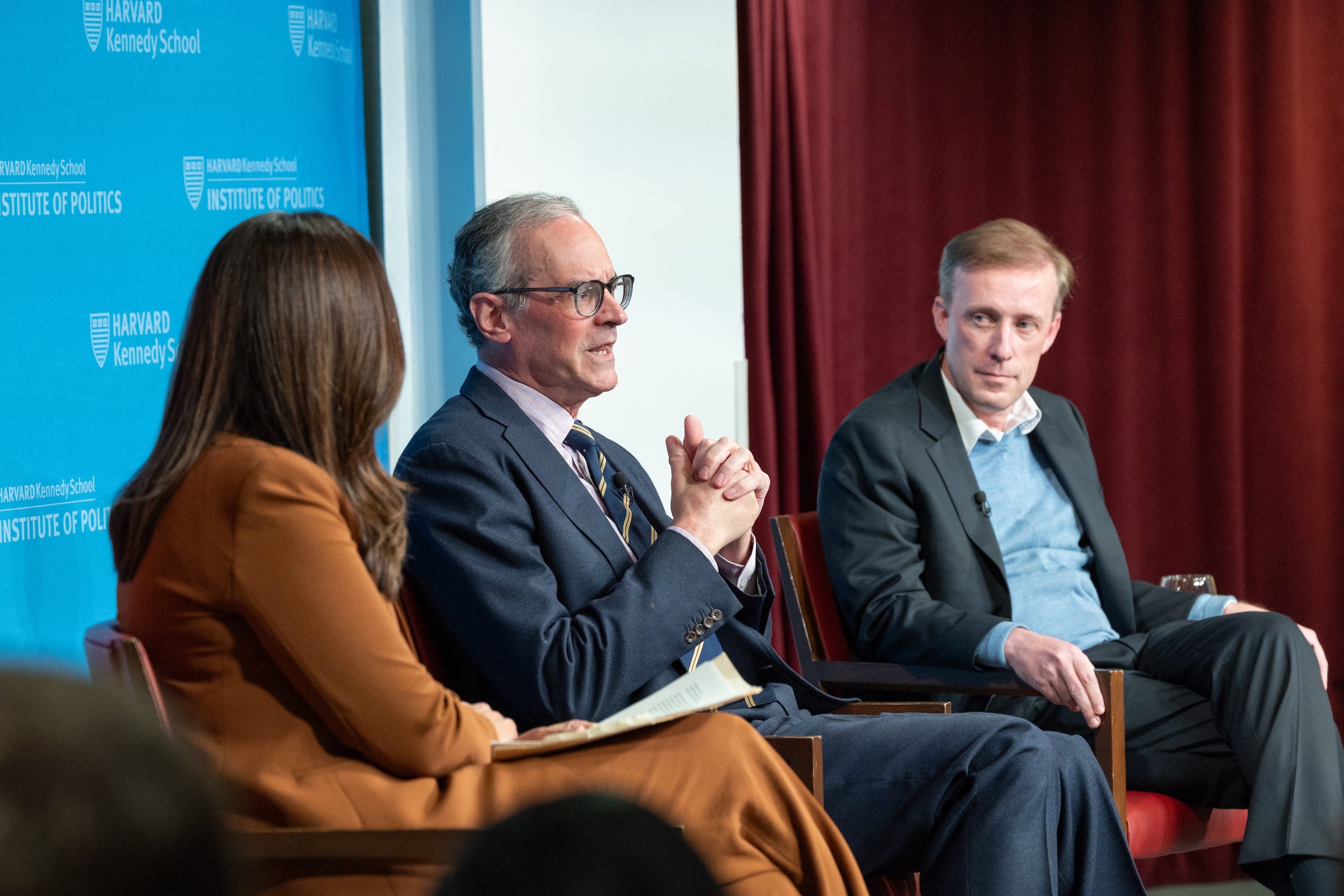
On October 19, Michael Anton, who ran the State Department’s Office of Policy Planning until September, told a full room at the Harvard Institute of Politics that the United States has spent three decades defining its national interest so broadly that it no longer has one. “If you focus on everything, you’re not really focused on anything,” he said. Sitting beside him was Jake Sullivan, former President Joe Biden’s National Security Advisor and now the Kissinger Professor of the Practice of Statecraft and World Order at the Kennedy School, who agreed with Anton’s diagnosis yet disputed practically every solution he offered and Amna Nawaz, the co-anchor of PBS Newshour, who moderated Anton and Sullivan’s debate.
Anton opened humorously mentioning. “Obviously I’m right of center and I work for Trump. I know what my assigned role is and I’m willing to play it,” he said. “So if you need me to twirl my mustache and tip the top hat, I can do that.” He then set out a case for restraint on foreign affairs. He discussed how America’s “core interests” have been redefined over the past forty years to slowly include more of the world, growing “until by the end everything is [considered one of America’s ‘core interests’].” The pivotal origin of this overreach, he argued, was a four-year argument inside the George H.W. Bush administration over whether to continue being the world’s policeman after the Cold War. The keep-going camp won, “by which I mean their policies were implemented, but it wasn’t really intellectually resolved.”
Anton said, however, that this policy came with a drawback. We simply cannot effectively defend the entire world’s interests because “Everything is finite. American power is finite. American money, American man-hours, American focus. We [have] got to pick and choose.” Instead of globalist foreign policy, Anton offered a short list of American core interests on which we should focus: “physical security, security of borders, security of infrastructure,” and the trade routes “without which American commerce cannot be safely or profitably conducted.”
Sullivan, meanwhile, declared that the object of foreign policy was the similar mission “to make the lives of the American people safer, better, and easier,” which implied prioritizing building an industrial base at home, maintaining alliances, winning our competition with China, and ending the post-9/11 wars. Agreeing with Anton, Sullivan said that American strategy documents “are not that good in general,” that “our neighborhood matters profoundly to our security,” and that Chinese influence in the Americas should be reduced. Where he disagreed was on the empirical question of whether recent administrations have in fact prioritized those American interests. Defending his time in the Biden Administration, Sullivan said that when Biden left office, “he was the first president this century who could say the U.S. is no longer at war. Now we’re back in war. And I think that comes at a cost to our capacity, our power, our credibility, and our purpose in the world.”
In spite of his stated opposition to American involvement in international wars, Sullivan was nevertheless supportive of American involvement in the Russia-Ukraine War. Sullivan castigated the Trump Administration’s moves of the previous ten days, among them waiving sanctions on Russian diesel, throttling Starlink “so that Ukraine has a harder time actually shooting down the Russian Shahed drones,” and the President “saying Zelensky’s got to go.” Sullivan declared defending Ukraine a moral mission: “If Ukraine just stops fighting, or the world stops helping Ukraine fight, it’s the end of Ukraine,” he said. “If Russia stops fighting, it’s just the end of the war.”
Anton, on the other hand, who took part in the 2025 negotiations to end the Russia-Ukraine War led by Special Envoy for Peace Steve Witkoff, said the offer to Moscow “was a very good deal for them, perhaps…but it would have stopped the fighting,” and that the deal failed because Russia would only accept deals based on “no terms you could offer.” Anton had an otherwise bleak view of the war effort. On the one hand, Anton said, Russia has spent enormous casualties on a shrinking population to hold “all of two oblasts, about half of another and a third of another, in four and a half years,” while on the other, American stocks of the weapons “are way down” because “we can’t produce this stuff fast enough” to supply Ukraine. Thus, he said, if Ukraine ended up without the Donbas, that would be “not a great outcome” but still an acceptable end to the war. Fundamentally, the disagreement returned to the two speakers’ understanding of American interests abroad. “How much of [Ukrainian territorial integrity] is really a core national interest of the United States?” Anton asked. “I think there we really disagree.”
On the Iran conflict, however, the positions reversed, with Sullivan defending the isolationist position and Anton the interventionist position. Sullivan, who had been part of the negotiations preceding the 2015 Nuclear Deal between the United States and Iran, called the current war “a folly from the start” and said that it was fundamentally misguided, as the Iran nuclear program cannot be ended by force: “Iran still has enriched uranium, it still has centrifuges, and it still has scientists.” Sullivan said that the best the President could do at this point would be to “retrench, cut a deal, get a deal in place and then try to essentially regroup.”
Anton, who met the Iranians three times last year during negotiations, described the sticking point of those negotiations as whether Iran could enrich uranium, which Tehran claims was not prohibited by the 2015 Nuclear Deal. Criticizing the deal which Sullivan had helped negotiate, Anton described it as ambiguous to the point where each side had believed that very different things had been prohibited by the deal, paving the way to the current conflict. He recognized, on the other hand, that the war with Iran had exposed capability gaps in the American military. “I didn’t know that the U.S. Fifth Fleet and all of our capabilities can’t keep the Strait open,” he said. “I thought that’s why we’re there.” Rather than view the war as a failure, Anton thought the war “could just kind of stop,” and that either way “we would still have pocketed all the degradation” of Iran’s nuclear and missile programs.
When discussing American operations in Venezuela, Sullivan and Anton disagreed on the effectiveness of the Trump Administration’s intervention. Anton called the January raid that removed Nicolás Maduro “an effective and justified use of U.S. power” against a designated narco-terrorist “in league with a hostile power an ocean away.” Sullivan agreed the operation was “absolutely remarkable” tactically but said that short-term impressiveness was a danger: “That can be intoxicating.” He argued this success led the President to try to apply the same strategy to Iran but then “came to learn: actually there was no Delcy Rodríguez [or other moderates in the regime].” Anton answered that Sullivan had misunderstood the goal of American intervention in Iran. Unlike Venezuela, nobody “sent Chinooks into Tehran,” and further argued that the administration recognizes that regime change in Iran “may be beyond the capability of the United States or Israel or the United States and Israel together.”
On the deeper, foreign policy-strategic level, Sullivan and Anton disagreed sharply on the ends set out by the current Administration’s 2025 National Security Strategy. Sullivan called its civilizational language “a real frontal assault on Europe for turning its back on its own civilizational heritage” and a departure from the American tradition. Anton, who was at the State Department when it was written, said he had been surprised by the extreme reaction which many on the left had to the document, “I complained to a few friends. I said, ‘We’re being attacked for saying to Europe, we love you, please live.’” Allies can only carry their share, he argued, “when they have a kind of inner confidence in who they are and their history,” citing Germany, where officials tell him “there’s something now kind of in the German national character that just really resists doing anything more in [military defense]” because of German national shame over their history. Nawaz, the moderator, offered Sullivan a reply to Anton’s response; Sullivan declined.
Anton further argued that allies like Germany have increased spending on their militaries because “they believed Donald Trump that this guy scares us. He may actually get out of the alliance.” Sullivan noted, contrary to Anton’s argument, that nine allies met the NATO target of members spending 2 percent of their GDP on their military when Trump first left office, while 23 did when Biden left. Anton offered, as a rejoinder, the fact that since the current Administration took office in 2025, every member but one has pledged to spend 3.5 percent of their GDP on their military, displaying Trump’s success at forcing European nations to spend on their own defense.
Anton, representing the Trump administration, understood the facts because he was there when the negotiations took place: he had sat across from the Russians and the Iranians and had sat in the briefings on what our military stockpiles actually hold. Sullivan disputed his conclusions but not his facts. Most of the students in that forum had only ever heard the case for strategic restraint from liberal interventionists who oppose it. For one night they heard that case from someone who had implemented it, and the man arguing against him could not say he was wrong.