

Harvard students are rapidly losing interest in the humanities. From 2010–2020, the number of undergraduates concentrating in English declined by over 50%, while the number of undergraduates in Computer Science doubled. In response, humanities departments have attempted to create courses specifically designed to appeal to students. Courses like Humanities 10 (Hum10) give students the opportunity to read the Great Books and discuss them in a group of intellectually serious peers. These courses ought to be successful by attracting an eclectic variety of minds and focusing them on the foundational questions underpinning the human condition—questions that have occupied the greatest artists and philosophers throughout history.
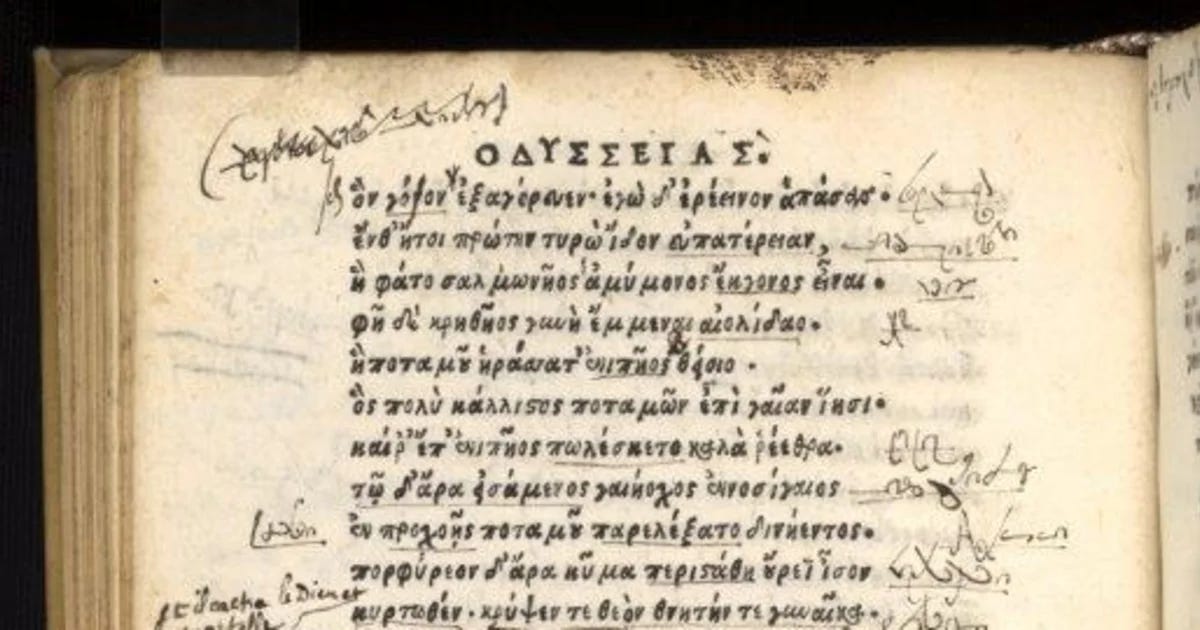
But when I actually attended Hum10, I was shocked to find that the human condition was not, in the minds of our professors, the point. Rather, we were asked to answer narrow academic questions. One of the essay prompts, for instance, asked students to identify a puzzling moment from the Odyssey: an interesting start. But what should this moment be shown to reveal? Perhaps questions about how Odysseus exemplifies goodness? No, we were rather just asked to connect this moment to more facts about the scene and the poem as a whole. Just the same with the Oresteia: rather than being asked about the serious questions with which Aeschylus grappled, students were instead asked to analyze a repeated theme, but only to reveal the “larger dynamics of the trilogy.” Instead of considering the most profound questions of meaning and existence, instead of using the books as a launchpad to interrogate how we live our lives, the scholarly conventions of the humanities force us into narrow analysis of texts that serve neither ourselves nor our classmates.
In this way, Harvard trains us to write purely academic essays—and to think in a purely academic style. We are being trained to search not for meaning, but for humanity’s search for meaning. From this perspective, it is not that Shakespeare illuminated something timeless about revenge or jealousy. Rather, he revealed interesting ethnological nuggets about how people in his time viewed revenge or jealousy—tidbits that are only valuable insofar as they can be put on a graph and contrasted to other times and places (negatively, of course).
This trend exemplifies a broader problem in the humanities. Professors do not recognize that students’ interest in courses on great literature is not a product of their own peripheral work. The model of writing that academic humanities departments not only promote but force on their students is meaningless. These courses do not teach students to think; instead, they destroy original thought. They do not preserve the beauty and power of great literature but obliterate it. They do not give insight into our lives; instead, they make us question why we’re investing them in the mundane task of textual analysis. Rather than facilitating the pursuit of truth, humanities academics ask us to engage in textual pedantry according to which ideas have value only insofar as they give insight into the text itself. Ironically, the actual ideas that the text aims to explore are explicitly set aside as irrelevant and implicitly understood to be trivial. The objective of a scholar is not to draw out the beauty and power of the text, but to analyze it in relation to other literary theories or the “historical context” which it supposedly could not possibly transcend. Never are the ideas themselves treated as worthy of consideration.
I suspect this is a major culprit for fading humanities enrollment. Not all of us (in fact, very few of us) want to be career academics. Yet we are all human; we are all searching for meaning in our lives. We all want to understand why we exist, how we can find happiness, how we should deal with pain and suffering, what kind of person we should become, what to love, what to build, what to hope for. These aren’t simple questions. To understand them, we have to learn about the stories writers have told, the worlds they have created, and the ideas they have understood. The humanities can therefore help us learn not just about the world that writers have sought to depict but the world that we actually live. If the sciences and social sciences can save lives, the humanities should save what makes a life worth living.
That sounds like a dull class indeed. Back when there were dinosaurs, and professors unafraid of independent thought, a similar class consisted of reading a book then while in class, being asked to debate some theme with the professor, such as "what constitutes a good life?". If the debate was going well then maybe five or ten minutes in the professor would stop the debate and we'd have to switch sides, with the student arguing the professor's position and vice versa. Grading was based on the ability to formulate and express logical arguments in real time, not on any specific viewpoint proposed and argued. And by no means did we do pedantic analysis to denigrate the works of the authors.
And Professor James Jones, should you read this, know these skills I learned and practiced under your tutelage have served me very well over the years, and I remain deeply grateful.
Excellent essay, and to the point.
It sounds like Hum10 is "Deconstruction 101."