


On October 16, at the Institute of Politics, Professor Jill Lepore, the David Woods Kemper ’41 Professor of American History and Professor of Law, hosted Steve Inskeep of National Public Radio, Jameel Jaffer of Columbia Law School’s Knight’s First Amendment Institute, and David French of the New York Times. Part of a series celebrating America’s semiquincentennial, this talk was titled “A Well-Informed Citizenry.” Yet, the persistent indecision, if not self-contradiction, of each of the three panelists would have made one think it was they, and not the citizenry, who needed to be concerned about being well-informed.
Inskeep opened the conversation by giving an account of media in the time of “scarcity” — namely, when print media was the only form of news media available to most people. According to his account, what defined news during that era, and what has been lost now, is printed speeches and other items in full, even (and especially) if the editors thought the content thereof was “horrible,” which allowed audiences to make determinations for themselves. This was “more valuable” than the media’s current modus operandi, which is instead to disseminate “the clip of the most idiotic thing that was said or something that wasn’t even said” to provoke a gut reaction.
On the topic of giving audiences the whole picture, Inskeep later lamented that many in middle America are unable to make sound political determinations because the government is too complex for them to properly assign blame for government failures, blaming his “industry as a whole, because it is sometimes actually hard work to figure out who is responsible for the thing the government did.” NPR, Inskeep’s employer, is a great example of exactly this oversimplifying failure. Over the past few years, the broadcaster has effectively determined that all sin originates in our President rather than any other element of the government. It is understandably hard, then, for its listeners to pin the tail on the right donkey: they have been given infinitely many tails, but only one ass.
French took time to caution against misplaced nostalgia for historic civic literacy, citing studies from the 1930s and 40s that found levels of political ignorance among the American population similar to those among 21st-century Americans. Instead, French insisted, what makes the contemporary media landscape so hindering to an informed citizenry is the emergence of a political and media class that “deliberately feeds on and magnifies [Americans’] civic ignorance.” He juxtaposed this elite class with the elites of the 1970s. In particular, he focused on the shock and horror which followed President Ford’s assertion in the second 1976 presidential debate that Poland was not tyrannically controlled by the USSR — at the time, French affirmed, there was a “form of consensus” in the media that “at least facts have to matter.”
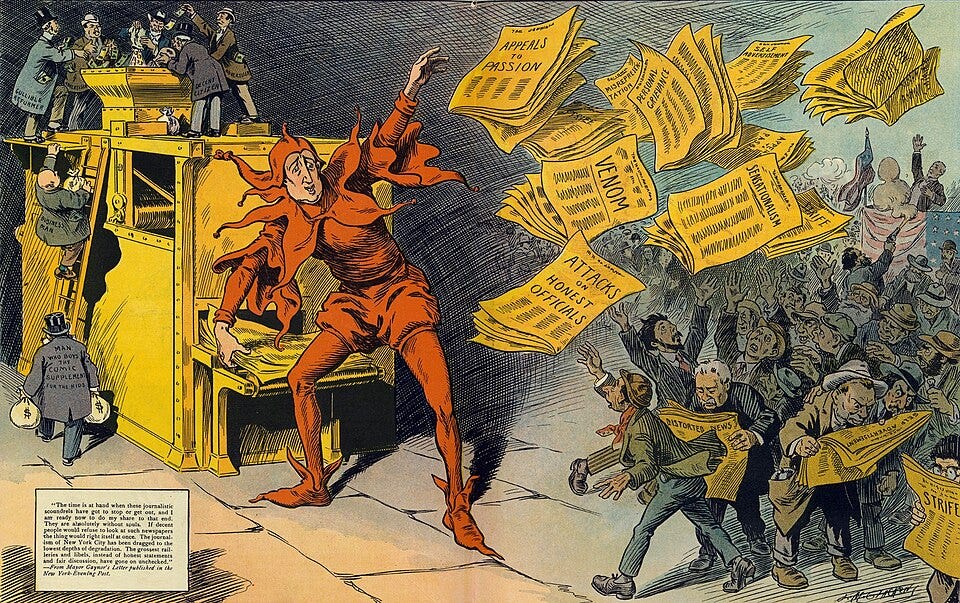
Yet, this seems ahistorical at best, and contradictory at worst. Demagogues have always plagued democratic societies, so much so that the critique dates back to the Socratics. Similarly, yellow journalism has a long history in the United States; it helped send us to war with Spain in 1898 (long before the 1970s). The sensationalist journalism and headlines of today are better understood as an extension of this historic trend. Instead, one of the few novelties of the modern media landscape is that modern journalists are so open about manipulating facts for progressive or social justice ends. Perhaps to French’s surprise, then, some of the most impactful players in “feed[ing] on and magnif[ying] civic ignorance” have been the outlets at which he works. Meanwhile, the only two major examples he gave of counterproductive media practice were conveniently right-wing — one related to Trump’s claims about missiles and the war in Ukraine, and the other about the right-wing media’s reaction to Critical Race Theory.
Still, the panel had its moments.
Lepore refreshingly asked about causes of an uninformed citizenry that do not have to do with the “important but [...] totalizing” role of tech. Inskeep responded by giving his “epidemiological” theory of news media. He argued that each party had treated the other’s media as diseased during certain portions of the last quarter-century. In the 2000s, the left fearmongered about reporters speaking directly to the military about Iraq because it thought that the military would corrupt the media; similar beliefs undergirded leftist hysteria about “platforming” conservatives throughout the late 2010s and early 2020s. Under the Second Trump Administration, Inskeep argued, a similar phenomenon was now happening on the right, as the administration declares leftists and their media personae non gratae at the White House.
But panelists appeared most eager to talk about the market — both during the opening round of remarks and audience questions. Unfortunately, there was little coherence on the topic.
The panelists bemoaned the death of local media. French gave a specific anecdote of a “beautiful” new public pool built in Nebraska, asserting that building such a pool was only possible because the relevant Nebraskans were not arguing over Critical Race Theory in their neighborhood schools — a “national issue” which French presented as distracting from more important local politics. Yet, the majority also seemed to agree that the widespread appetite for national news over local news was the result of consumer appetite. This anecdote displayed the general difficulty panelists had in understanding what sorts of things matter to people. Only journalists could be surprised and appalled by parents being more interested in what their son is learning than in whether he will be able to try out his breaststroke over the summer.
More egregiously, returning to French’s President Ford example, the media landscape of that time worked, according to French, because there was a “consensus” among a “real consolidation” of national media, which consisted of “ABC, NBC, CBS…PBS.” That is, the sort of mutual commitment to “facts” that the panel sought was only possible in a world with an effective oligopoly of information run by multinational conglomerates, which prevented any single source from “reinforc[ing] your priors” as (according to French) media does today. Nevertheless, at the first question from the audience, Inskeep quipped about the media being consolidated into a single company, which drew laughs from the fellow panelists and audience.
While nobody serious wants a monopoly on the media, the instinct to laugh at consolidation and demand more local news — to seek out a more democratized or locally sourced media landscape — appears to contradict the laudatory view of the 1970s model of media that French presented. It is impossible for the modern news media to achieve any sort of meaningful agreement on “truth” because, unlike in the 1970s, it is dispersed across many outlets. As such, it seems like encouraging less consolidation and creating more local news could only make the situation worse.
The panelists could thus not escape countervailing liberal principles: on the one hand, that centralized corporations are inherently evil and that, as Jaffer noted, capital does not conduce to democracy; on the other hand, that it is necessary to have a centralized media ecosystem that can agree on notably progressive standards of “truth.” But perhaps these two beliefs are not as contradictory as they first seemed. As Democrats harass conservative media moguls and try to sue businessmen to avoid conservative editorial control over any mainstream media outlet, the left realizes both parts of the panel’s vision: media is kept democratized, but its component parts are censored and thus forced to conform to a leftist view of what cultural issues are “important” and what facts are fit to print.