

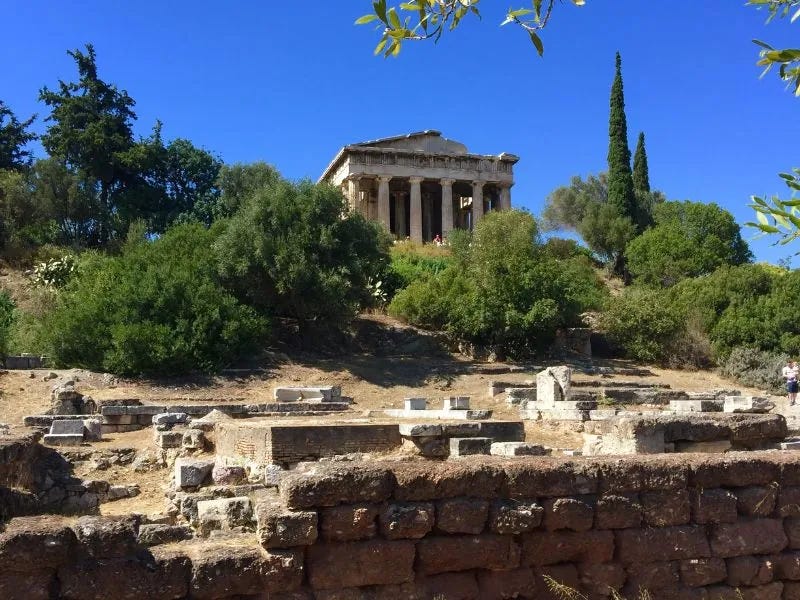
The curtain opens. The audience quiets. The air buzzes with excitement for a play millennia in the making. Teachers at the Academy, Aristotle, Kant, and Kierkegaard gaze upon the production from box seats, while Plato is characteristically absent. Their students watch from the ground floor, each ticket stub reading the date and seat number, along with the title in bold: The Tragedy of the Academy.
Our protagonist, like that of all other great tragedies, is one who, in an attempt to do good, releases unintended havoc upon the world. Hamlet, seeking justice for his father, dooms his entire family. Oedipus, in his attempts to outrun fate, fulfills prophecy. Lear, seeking stability, splits his own kingdom. And in this play, our hero, Humanitas, seeking the betterment of Man, has brought about his own rejection.
Aristotle, addressing the great thinkers around him, describes the essential aspects of Tragedy. “Hamartia!” he proclaims: the fundamental error of the tragic hero, the seal of his often ironic fate. Hamartia is what makes those who seek life find death, those who seek justice find lawlessness, and, in our case, those who search for meaning find purposelessness. Humanitas strove to improve the people around him, to forge character in the furnace of culture. Yet, from him emerged Scientia, who rejected the humanistic progress that Humanitas thought would lead to the betterment of humans themselves.
In many tragedies, this world-inverting mistake results from the protagonist’s hubris and blindness to potential repercussions. One of Aristotle’s students asks, “What was the grave hamartia of Humanitas?” At this, Aristotle falls silent, unwilling to speak without understanding: The hero’s fatal flaw had not yet been revealed.
The play continues. Humanitas, in his devotion to refinement, drifts from his purpose. Intoxicated with the beauty of rhetoric, he teaches his students how to argue but never how to wonder. His pupils study as if nothing were at stake; they can break down but not build, dissect but not give life; their ideas are ribcages without lungs or a heart.
At the climax of the production, Humanitas begins a monologue directed at his child Scientia, who led an overthrow of his father from the Academy:
“Why do you reject me so? Why do you think you can live without me?
I oversaw your birth. I ushered you into the world.
Remove yourself from my company and you will see,
A hand without an arm can only grasp at rocks and dirt.”
By this point in the drama, St. Augustine, carefully avoiding a disordered love of theatre and emotional excess, applaudes Humanitas’ speech. He reminds those around him that it is better to own a tree, know its Creator, and eat from it than to know the tree’s height and width and its number of branches, while enjoying none of its fruit. At this, the students on the ground floor began to growl. One calls out, “Humanitas’ fruit is bitter and rotten!” Another bellows, “At least Scientia is practical.”
They see science as the means by which man is made healthy and lives are improved. But they forget that the humanities, not the sciences, taught us that it is better to be healthy than sick and that human life has infinite value. In this way, the fruit is a life well-lived, not mere progress. It was the humanities which brought the sciences into the world for a simple reason: to discover what is so that we can build what ought to be.
The humanities must direct that knowledge toward the Good. The sciences can keep us alive, but the humanities ask why that life is worth living. In the decline of Humanitas and the dilapidation of his aged halls, the world increasingly rejects that humanity is a part of its progress. Technology and science may improve, but what about character? Will Humanitas remember who he is, who we all are, before it is too late?
The box seats weep. The ground floor cheers. The curtain closes.
Absolutely fantastic. Thank you so much. This post can go a long way to restore Humanitas. We work hard alongside you with our Classic Film Study Project - piloted Mr. Smith Goes to Washington and others with college students, classic movie storytelling. I love this post and thank you ....from Dr. Onalee McGraw, Director EGI classic film study project....
Well played.
Do we not find ourselves at a providential crossroads…?
A time when Anthropic has lost its control of its Mythos program.
A time that has come upon us in too clandestine manner that Human 2.0 is our replacement.
Great thoughts and inductive Scientia have led us here….
With what next for Humanitas?