

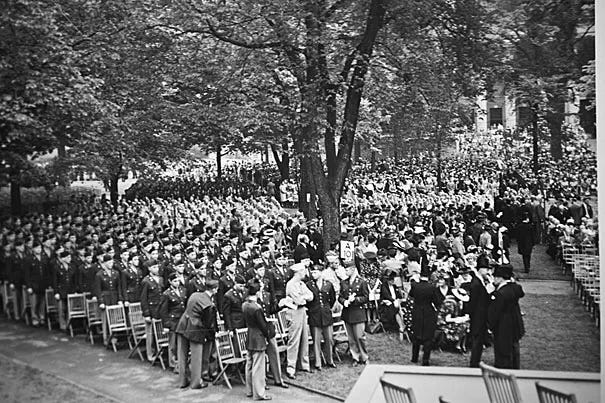
It feels trite to look back at Harvard’s history and say the good old days are over. The relatively merit-based Harvard of today, after all, serves an important role that the Harvard of the 1920s, when the main admissions criterion was your last name, did not fulfill. Returning to that time would be both impossible and undesirable. Nevertheless, there is a value that this historic Harvard held which we have since lost: a service-minded attitude.
Walk into Memorial Church, and you will see the names of Harvard students who, in times of national crisis, sacrificed their lives to crush fascism, end slavery, and defend this country. Read about the history of the college’s student organizations, and you will find stories of the Hasty Pudding Theatricals stopping their show so the cast could fight in World War One and Two. Or look back to 1919, and you will find the entire 125-man football team deputized to put down civil unrest following the Boston police strikes. (It’s hard to imagine the modern Harvard student putting down a riot; more likely, we’d be the ones trying to start one.) Extending beyond the students, this spirit of service characterized the entire institution. When the United States set out to establish a public school system in the Philippines in 1901, Harvard was the largest private institution represented in the mission.1
It is difficult to imagine today’s Harvard massing enough students to serve the Commonwealth, our country, or even humanity as it had in the past. But this is not to say that individual students don’t have these aspirations. Harvard has a remarkable number of students who enter with the vision that they will make some kind of significant positive social impact. To many applicants, Harvard ought to serve as a stepping stone in realizing their positive and impactful goals. Just as remarkable as this meaningful impulse, however, is Harvard’s ability to slowly crush these passions.
Over the course of a student’s four years at the college, a student sees pre-professional programs and lucrative opportunities—oftentimes in consulting, finance, or technology–dangled in front of them. Regardless of how much someone’s concentration or post-graduation plans differ from these fields and their associated organizations, the allure is difficult to resist. New students flock to clubs that promise to help them succeed in industries that they previously could hardly define. As a result, where community organizers and artists enter, consultants and junior analysts leave.
While many who go this route claim that it is temporary or that they will practice some form of “effective altruism,” it is hard to take these sentiments at face value. When a young Harvard graduate spends half a decade at one of these companies, it’s natural that their preferences shift, and any idealism may be supplanted by a sense of comfort. Once you sell your soul, it’s hard to get it back.
While selling out is not unique to Harvard, we seem to have distilled it into a formula. According to The Economist, in the 1970s, 5% of Harvard graduates went into finance and consulting. By the 1980s, the figure was 20%, 25% in the 90s, and today, that figure hangs around half of a graduating class. In that time, not only have large consulting firms and financial institutions started actively recruiting from the college, wining and dining students at lavish events, but Harvard students themselves have joined in, creating soulless clubs with the express purpose of connecting 18–22 year old “Associates” and “Case Team Leaders” with consulting firms, placing them in summer internships and full-time jobs.
Harvard’s undergraduate pre-professional experience has become so absurd that 20 Harvard students each year pay nearly $6,000 dollars for a consulting internship in South Africa. Through DiiVe, a consulting firm which claims to “provide purpose-led experiential learning through high-impact, hands-on, client-facing consulting internships for smart, empathetic and ambitious students,” (whatever that means) students from every competitive liberal arts college pay the cost of a 2015 Honda Civic to spend five weeks making Powerpoints for a consulting firm. For these students, Harvard is not an educational institution—it’s a job training program.
Most disappointing is that many of these students do not need the money a career in finance provides. In fact, a disproportionate number of those who go into high-paying, low-social impact jobs are from wealthy backgrounds. Students from families in the top decile of household incomes are 1.5 times less likely to choose public sector and non-profit careers than other students. It makes sense that students from difficult socio-economic backgrounds would want to pursue high-paying jobs immediately after graduation. But for the more than 50% of students whose families are in the top decile of earners, to use the advantages they have been handed simply to create more wealth for themselves reflects a failure in these students’ moral education.
Some may shrug this issue off as a failing of “Capitalism,” separate from questions of morality. But that assumption reveals the core problem that Harvard students face. America is a capitalist country, but Capitalism is not the summation of America is or should be. The Harvard men that came before us understood that what makes this country exceptional is that we have the freedom to pursue what we like, even finance and consulting. But if we, the most well-resourced and educated young people in this world, are unwilling not only to protect our society but also to enrich it, that freedom will slowly fade. And when an institution like Harvard fails to live up to its mission of helping talented young people discover how they can “best serve the world,” that institution begins to exist solely to perpetuate itself and its influence. Fortunately, this outcome is not inevitable. It is our responsibility to reform the culture we inherited and failed to change, both for the good of Harvard and for this country. But real reform does not begin with abstract critiques of culture. It begins with us students choosing service over convenience and responsibility over resume.
Kirkwood, Patrick M. “‘Michigan Men’ in the Philippines and the Limits of Self-determination in the Progressive Era.” Michigan Historical Review, vol. 40, no. 2, 2014, p. 63, https://doi.org/10.5342/michhistrevi.40.2.0063.
Also, today 27% of the entire student body is non-American when back in 1900 it was estimated to be 1 to 3%. Non-Americans aren't going to care so much about 'service' at least in the USA - and most today don't even go back to their home countries to 'help out.' Not to mention that the Protestant Work Ethnic that reigned in earlier days has essentially been obliterated....
It is a bit surprising that a conservative publication would bemoan a preference of a number of classmates to go into business rather than “service” whatever that means. I suspect that our economy suffers from too many graduates in recent years learning little while in college and seeking (as well as having to) find jobs in government or nonprofits that advance leftist ideals, only to find that when, like now, government largesse and sinecures dry up, there is no “service”to be provided. A more familiar route to a fulfilled life can be found in the descriptions of candidates for Harvard Overseers who generally distinguish themselves both in their professions and in their good works along the way.