

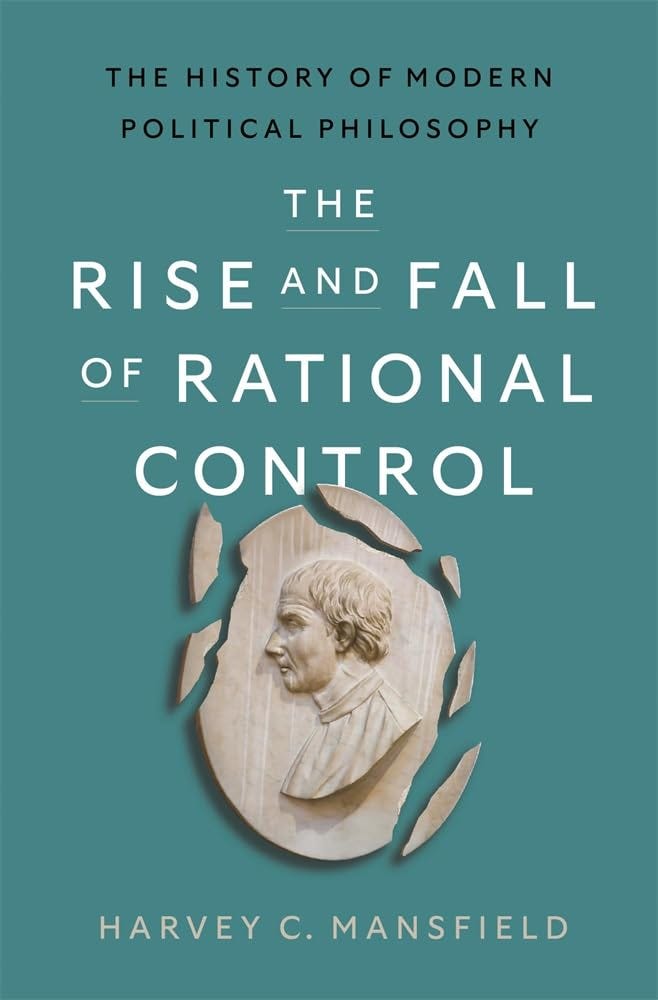
Harvey Mansfield, emeritus Harvard professor of Government and intellectual historian, revisits the political philosophical arc of modernity in his recent book The Rise and Fall of Rational Control. Drawing heavily on the structure of his famed Government 1060 course, Mansfield presents modern political thought as a coherent project originating with Machiavelli’s break from classical restraint and propelled by the promise that reason can establish and maintain fortune, passion, and power for those who properly harness it. Starting with Hobbes and Locke and progressing through Rousseau, Kant, Hegel, and Marx, Mansfield traces the development—and eventual exhaustion—of this modern intellectual self-confidence. Mansfield’s argumentation is elegant, disciplined, and clarifying, offering a tightly reasoned account of modern political philosophy’s internal logic.
Mansfield elucidates what he takes to be the gradual erosion of the Machiavellian project as modern political philosophy unfolds across the centuries. When reason becomes increasingly detached from virtue, the promise of rational control gives way to instability. When the pursuit of power can be justified solely by its ends, all means become permissible, and justice loses its moral grounding. Mansfield’s account of modernity culminates in Nietzsche, whom he presents as both a penetrating diagnostician of modern thought and an unwitting herald of modernity’s collapse.
For Mansfield, Nietzsche marks the decisive turning point at which modernity’s confidence in rational control finally gives way. By exposing reason, morality, and truth as expressions of will rather than objective standards, Nietzsche dissolves the philosophical foundations that had sustained modern political thought, even as he seeks to replace them with a new affirmation of strength and self-creation.1 Mansfield argues that this move does not inaugurate a stable alternative, but instead clears the ground for postmodernism: a condition defined less by Nietzschean excellence than by the proliferation of competing perspectives without any shared measure of judgment.2
Nietzsche’s critique of Christianity plays a central role in this final movement. Christianity, as Nietzsche argues, represents a moral framework no longer suited to modern life: one that devalues strength and ambition, denies the worldly significance of hierarchy and rank, and replaces excellence with a flattening doctrine of equality.3 In rejecting Christianity, Nietzsche intentionally clears the ground for a postmodern perspective. He argues that modern rational control will not last because it gives way to competing viewpoints, rather than shared moral or political standards.
Mansfield’s description of the demise of modernity is forceful but not exhaustive. Nietzsche’s critique of Christianity is undeniably scathing, yet Mansfield’s presentation occasionally risks accepting its premises too readily. Christianity does teach that all men are created equal, indeed, but this does not imply the flattening of society that Nietzsche describes. This is because the Christian view of “equality” refers to dignity and moral worth before God, and thus does not imply the elimination of hierarchy, authority, or obligation within political life.4 Indeed, the New Testament repeatedly affirms the value of labor, stating in 2 Thessalonians 3:10, “If anyone is not willing to work, let him not eat.”5 The New Testament even explicitly calls for submission to governing authorities as a necessity in an ordered social world: “Let every person be subject to the governing authorities. For there is no authority except from God” (Romans 13.1).6 Far from rejecting structure or merit, Christian teaching presupposes them, grounding hierarchy not in domination but in responsibility.
Moreover, Christianity may offer precisely the moral tethering that Mansfield views as necessary for a renewal of virtue in a world dominated by postmodern relativism. As Mansfield argues, in the absence of shared standards, appeals to virtue risk becoming merely instrumental, valued because they contribute toward some other end rather than because they are in themselves true or good.7 Christian moral thought, by contrast, presents virtue not as a pragmatic tool for governance but rather as being ordered toward fulfillment. Christianity gives a satisfying story of virtue, rather than leaving it contingent on arbitrary factors like one’s personal circumstances or success. In this sense, Christianity does not undermine the recovery of ancient virtue Mansfield invites, but rather completes it, preserving the classical concern for excellence while anchoring it in a moral horizon resistant to normative subjectivism.
Mansfield succeeds in outlining the intellectual conditions that led to modernity’s apparent exhaustion and in leaving the reader unsettled by the implications of postmodern thought. In doing so, it makes the reader ask themselves questions about how we got here and how we ought to respond. Ought we, having wandered so far, return to the wisdom of the ancients? Should we attempt a renewal of classical traditions centered on virtue? Mansfield largely succeeds in making a successful case for the affirmative. However, Mansfield does not recognize that such renewal can only truly escape the perils of relativism by anchoring wisdom and virtue in objective truth. Mansfield succeeds in The Rise and Fall of Rational Control to set forth a brilliant philosophical anatomy of modern thought, but leaves readers to contemplate whether a renewal of a classical virtue-based political philosophy like the one he would favor is sustainable unless it recognizes the very Christianity that Nietzsche cast aside.
Harvey C. Mansfield, The Rise and Fall of Rational Control: The History of Modern Political Philosophy (Chicago: University of Chicago Press, 2025), pp. 270–272.
Ibid., p. 269.
Ibid., p. 266.
Thomas Aquinas, Summa Theologiae, Part I, Question 96, trans. Fathers of the English Dominican Province (New York: Benziger Bros., 1947).
The Holy Bible, English Standard Version (Wheaton, IL:Crossway, 2016), 2 Thess. 3:10.
Ibid., Rom. 13:1.
Harvey C. Mansfield, The Rise and Fall of Rational Control: The History of Modern Political Philosophy (Chicago: University of Chicago Press, 2025), pp. 259-260.
Excellent commentary.
Excellent essay.