

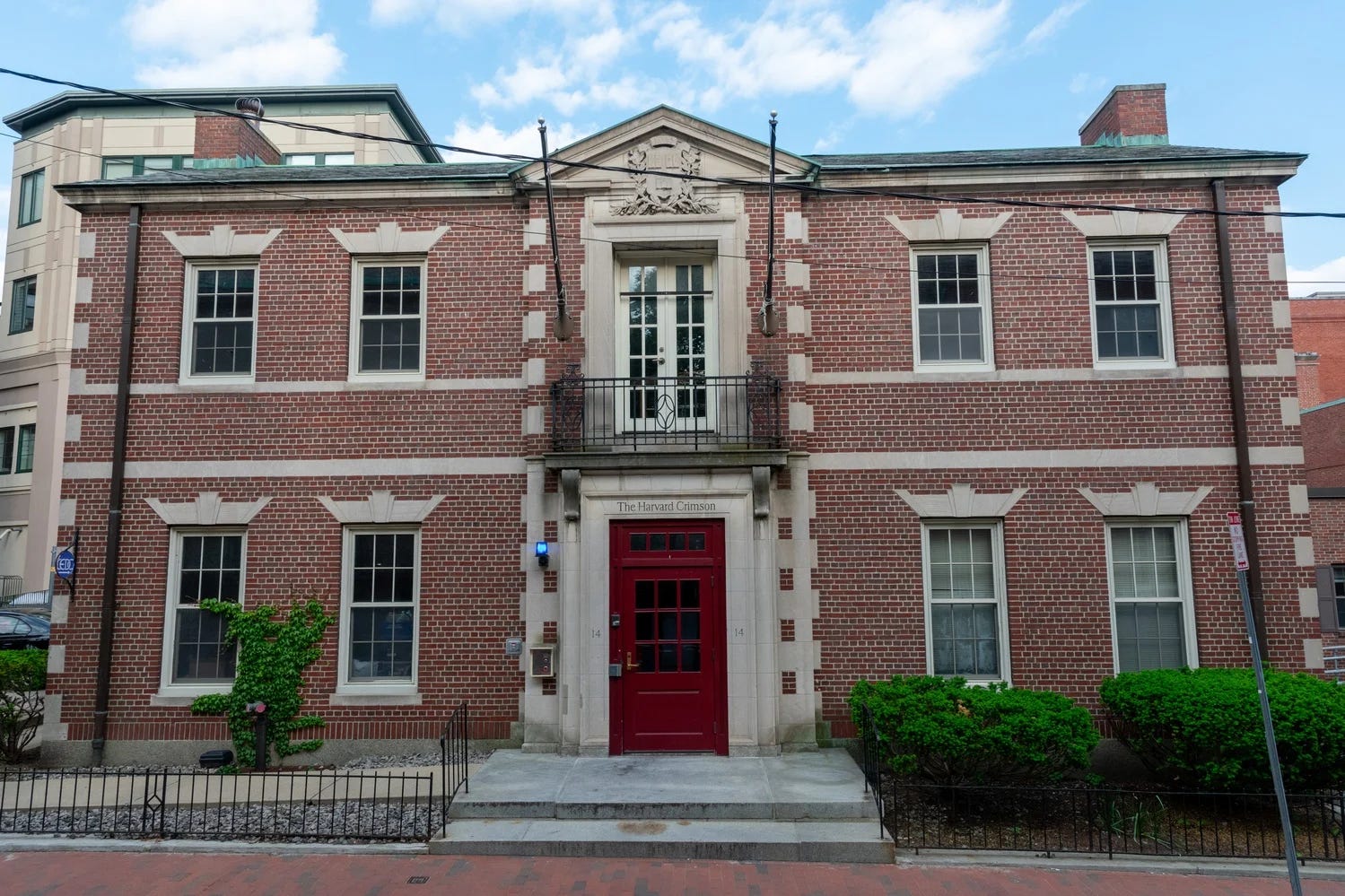
The Harvard Republican Club’s (HRC) recent rejection of Republican values should have been a unifying moment, when all students, conservative and liberal, can come together and defend religious liberty at Harvard. However, Harvard’s largest newspaper, the Crimson, has chosen in the past week to use this moment to amplify the message of an organization with extremist views, the Council on American-Islamic Relations (CAIR). In doing so, the Crimson has tried to smuggle extremist viewpoints into Harvard’s discourse under the guise of “civil rights.” This is unacceptable. CAIR is not a “civil rights group,” as the Crimson has described it. It is in fact an extremist organization that has, as we will show in this article, defended domestic abuse and antisemitism. Instead of being amplified, this extremism must be rejected.
In two articles, coming out within 24 hours of one another, the Crimson amplified CAIR’s criticism of Harvard. Following the HRC’s post about Harvard Eid celebrations, CAIR complained in a letter and a Tweet about “false allegations of antisemitism,” while demanding Harvard take action against the HRC. It is a slightly odd decision to report on this – the Crimson does not usually report on outside groups condemning the school, let alone clubs at the school – but this is not in itself especially suspect.1
The second Crimson article, however, was odd. This article covered a seven-month-old letter (presumably provided to the Crimson by CAIR) which CAIR had sent to Harvard criticizing its policies against antisemitism. In the Crimson article, CAIR is presented as a benign “civil rights group,” while Harvard is shamed for not having responded to CAIR’s demands for less action against antisemitism. This is not news. It is the propagandistic amplification of CAIR’s previous advocacy efforts and, simply put, an attempt to inject CAIR’s views into Harvard public life.
And CAIR’s views, we will make clear, are extreme. CAIR has sought to train police officers to avoid prosecuting domestic abusers in favor of “counselling” with religious authorities.2 Indeed, CAIR allegedly overlooked allegations of sexual abuse within its ranks for nearly half a decade, driven by the same extremism that led them to avoid action against domestic abuse. Furthermore, CAIR has faced consistent allegations that it discriminates against non-Muslims, against non-Sunni Muslims, and against women.3 The Muslim women whose beatings CAIR allegedly covered up and who were discriminated against might be shocked to hear the Crimson’s assertion that the entire time, CAIR is a defender of “civil rights.”
Notably, of course, where CAIR has proven most directly opposed to civil rights is in its approach towards Jews. CAIR has consistently defended antisemitism. CAIR Executive Director Nihad Awad stated that he was “happy to see” the October 7th terrorist attack against Jewish civilians in Israel; indeed, Awad had previously worked for an organization directly funded by Hamas. Even after his remarks led to CAIR being blacklisted from the United States government, Awad has remained CAIR’s Executive Director, showing how ideologically committed they are to extremism.
Indeed, in the past few months, CAIR has continued defending antisemitism, no matter its ideological source. For instance, CAIR has praised Carrie Prejean for her statements defending conspiracy theories about Jews. Indeed, they have promoted Prejean even after she endorsed James Fishback’s fringe and openly antisemitic run for Governor of Florida. CAIR’s persistent defense of antisemitism helps to properly contextualize its attacks on Harvard’s actions against antisemitism. CAIR is less motivated by an interest in the “civil rights” of Muslim students as they are by a (negative) interest in the civil rights of Jewish students. Of course, the Crimson did not provide the basic context necessary for readers to understand CAIR’s suspect perspective.
The President of the Crimson did not respond on the record to our request for comment.
The Crimson’s amplification of the extremist CAIR has been so egregious because it is completely unwarranted. CAIR is not a significant group with influence over Harvard; when the administration received CAIR’s letter, it responded with a template message about referring to the University’s guidelines.
CAIR does not represent a vast majority of Muslims in America. Indeed, a Gallup center poll states only 12 percent of American Muslims feel that CAIR represents them. CAIR has even allegedly misled donors to receive donations from people who do not support their radical agenda. The United Arab Emirates, a Muslim nation, has even officially classified CAIR as a “Terrorist Organization.” Indeed, CAIR’s radical ideology and extreme distance from mainstream America is why the organization has allegedly been reduced to relying upon surreptitious foreign funding.
That the Crimson would unquestioningly inject extremists like CAIR into Harvard debate for the sake of clicks and quotes is an indictment on its seriousness as a journalistic institution. It is imperative that we all avoid bigoted extremism, whether coming from CAIR, the HRC, or even the Crimson. Hopefully, the Crimson can recognize its failure to defend against bigotry and retract its inaccurate and dangerous depiction of CAIR as an innocuous “civil rights organization.”
Earlier this year, for instance, the Coalition of Hindus of North America, a major Hindu advocacy group, condemned Harvard’s South Asian department for an “offensive” image; the Crimson only reported on the condemnation when the department took down the image a week later.
Gaubatz, Dave, and Paul Sperry. Muslim Mafia. WND Books, 2009, pp. 78-9.
Gaubatz, Dave, and Paul Sperry. Muslim Mafia. WND Books, 2009, pp. 155-7.
The irony of it all is that when Islam fully dominates a country with Sharia Law, many of the cultural hallmarks that liberals cherish most - music, literature, free speech, fashion - will be haram.
(Think "Das ist verboten").
It should be noted that one of the students given a pre-trial diversion instead of more serious punishment for assaulting a Jewish student in a demonstration at Harvard Business School was given a $65,000 Harvard Law Review fellowship to work at CAIR. This reflects badly on CAIR and the Harvard Law Review. Furthermore, because Harvard University has some leverage over the Harvard Law Review (use of the Harvard name and a domain name containing Harvard, and involvement of faculty members) it also reflects badly on Harvard University.
Details at https://www.theeditors.com/p/harvard-law-review-gives-65000-fellowship-to-bharmal